
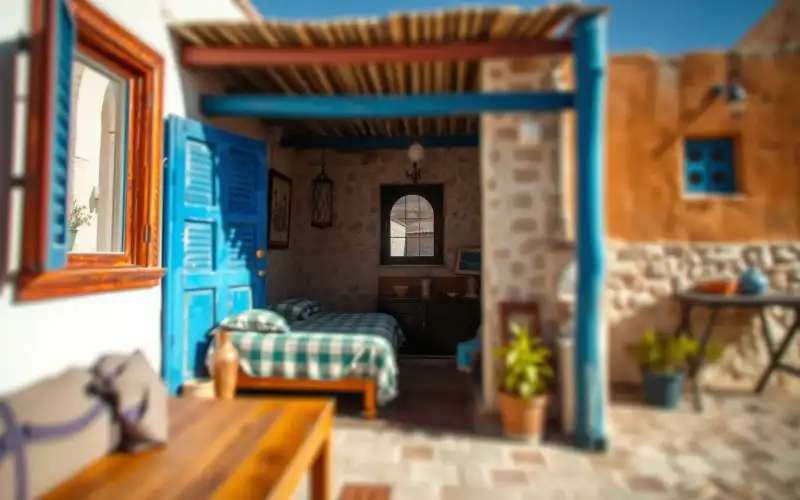
Last April, I found myself sitting in a guesthouse kitchen in Dipkarpaz at half past seven in the morning, watching an elderly woman named Selma knead dough for the day's bread. The hotel I'd stayed in the previous week—pleasant enough, with its sea-facing terrace and reliable WiFi—suddenly felt like a different country entirely. This is the essential tension facing anyone planning a longer stay on the Karpas Peninsula: do you want the structured comfort of a coastal hotel, or the unpredictable intimacy of a village guesthouse where breakfast might include homemade preserves and a conversation about your host's grandson studying in Nicosia?
The choice isn't simply about budget, though that matters. It's about what kind of traveller you are, and what the peninsula will show you depending on where you lay your head at night. After spending five seasons moving between both types of accommodation across the eastern villages and the shoreline, I've learned that the decision shapes everything: your mornings, your dinner plans, the people you'll meet, even the light you'll see when you wake.
The Village Guesthouse Experience: Pace and Presence
A traditional Karpas guesthouse—and I mean the genuine article, not a renovated villa marketed as "boutique"—typically occupies a converted family home in villages like Dipkarpaz, Rizokarpaso, or Agia Trias. These establishments usually have between four and ten rooms, often with shared or en-suite bathrooms depending on the level of recent investment. Prices in 2026 range from €35 to €65 per night for a double room, with breakfast often included or available for an additional €5 to €8.
What you're paying for, fundamentally, is access to a different rhythm. Most village guesthouses don't have a reception desk in the conventional sense. You'll meet the owner—usually a local family member—who might be tending the garden, preparing the communal kitchen, or simply sitting with a coffee. The accommodation becomes less a transaction and more an arrangement. I stayed at a place near the Apostolos Andreas Monastery where the owner, Nicos, simply left the front door unlocked and a key on the hall table. No check-in procedure, no key card, no front desk hours. If you needed something at midnight, you knocked on his family's door upstairs.
The rooms themselves tend toward simplicity. Expect clean, functional spaces with perhaps a ceiling fan, a basic shower, and bed linen that's been washed thoroughly but might show its age. Many guesthouses have been running for fifteen to twenty years without major renovation—which can mean either charming authenticity or dated plumbing, sometimes both simultaneously. The WiFi, if present, works intermittently. This isn't negligence; it's simply that the internet infrastructure in these villages remains patchy, and the owners aren't running hospitality operations with the resources to guarantee five-bar signal.
What distinguishes the guesthouse stay is the breakfast situation. Rather than a buffet in a dining room, you'll likely find yourself in a kitchen or courtyard with fresh bread from the village bakery, local cheese, olives, perhaps eggs, and whatever preserves the owner's wife has made that season. One morning in Rizokarpaso, I was offered quince paste so intensely flavoured it tasted like concentrated autumn. The owner's daughter sat with me while I ate, practising her English and asking about London. These moments don't appear in hotel reviews, but they're what people remember years later.
Coastal Hotels: Convenience and Consistency
The coastal hotels along the Karpas—concentrated mainly around Nagomi and the northern beaches, with a cluster near Famagusta's edges—operate under entirely different assumptions. These are proper hotels: reception desks with set hours, standardised room configurations, printed information folders, and a clear separation between guest and staff. Prices for a double room run from €75 to €140 per night depending on proximity to the best beaches and the season, with breakfast typically an additional €10 to €15 per person.
The advantages arrive immediately upon check-in. Your room will have air conditioning that actually works, a private bathroom with hot water on demand, a television, and usually a balcony or terrace. Many coastal hotels offer sea views—genuine views of the Mediterranean, not glimpsed between buildings but properly framed. WiFi is reliable and password-protected. There's a reception desk available until at least 10 p.m., often 24 hours. If something breaks, you call a number and someone fixes it the same day.
Breakfast at coastal hotels follows the international standard: a buffet with cold cuts, cheese, bread, cereals, yoghurt, and fruit. It's competent and familiar. You won't discover new flavours, but you won't be surprised either. Some hotels add a hot element—fried eggs or pancakes—depending on their category. The dining room is typically separate from the reception, with set breakfast hours between 7 and 10 a.m.
The rooms themselves reflect current hospitality standards. Furniture is relatively new, beds are firm, bathrooms are tiled and functional. Many hotels have been built or substantially renovated within the last ten years. The overall effect is reassuring: you know what you're getting. There's no mystery about water pressure or whether the electricity will hold. This consistency appeals powerfully to travellers who've had bad experiences with independent accommodation, or who simply want to relax without logistical surprises.
Cost Comparison: The Real Numbers
The financial difference becomes significant over a week or longer. Consider a one-week stay in 2026:
| Accommodation Type | Nightly Rate | Weekly Cost (7 nights) | Breakfast Included? |
|---|---|---|---|
| Village Guesthouse (mid-range) | €45 | €315 | Usually yes |
| Coastal Hotel (mid-range) | €95 | €665 + €70 breakfast | No (extra) |
| Budget Coastal Hotel | €75 | €525 + €70 breakfast | No (extra) |
| Premium Village Guesthouse | €60 | €420 | Yes |
A week in a village guesthouse costs roughly €315 to €420 all-in. The equivalent coastal hotel stay runs €595 to €735 including breakfast. That's nearly double, sometimes more. Over a month—the sort of stay slow travellers often make—the difference reaches €2,000 or more. For British pensioners on fixed incomes, this gap matters substantially.
There are cheaper coastal options, particularly smaller family-run hotels in villages like Agia Trias that sit between the guesthouse and full hotel model. These might charge €60 to €75 per night with breakfast included, narrowing the gap significantly. However, they offer fewer amenities than proper hotels and aren't always easier to book—many operate through word-of-mouth and local recommendations rather than online platforms.
Location and Daily Life: Where You'll Actually Spend Your Time
Staying in a village guesthouse places you within the actual fabric of Karpas life. Your accommodation sits on a street where locals walk daily. The bakery is fifty metres away. The kafeneion—the traditional coffee house—is typically within a five-minute walk. You'll see the same faces repeatedly: the woman who runs the small supermarket, the men playing backgammon, the children cycling home from school. This isn't tourism; it's proximity to how people actually live.
Coastal hotels sit apart from this rhythm. They're positioned for beach access and sea views, which usually means some distance from village centres. You'll need transport—a rental car, a taxi, or a willingness to walk twenty minutes or more—to reach restaurants, shops, or the kafeneion. The hotel becomes your social and practical centre. Breakfast, lunch, and dinner can all happen within the hotel grounds. You could spend days without entering a village proper.
For exploring the peninsula's attractions—Apostolos Andreas Monastery (40 kilometres from Dipkarpaz), the Golden Beach, the Karpas Archaeological Museum—the coastal hotels offer slightly better logistical positioning, being closer to main roads. Village guesthouses require planning: you'll need to arrange transport or rent a car. This isn't a disadvantage for slow travellers accustomed to thinking ahead, but it's a practical difference.
Amenities and Facilities: What's Actually Available
This category reveals the clearest trade-offs. Coastal hotels typically offer:
- Swimming pools (some heated in winter)
- Beach access or beach clubs
- On-site restaurants or dining arrangements
- Room service
- Laundry facilities (sometimes paid)
- Air conditioning and heating
- 24-hour reception and security
Village guesthouses rarely offer more than:
- Basic kitchen access (sometimes)
- Courtyard or garden space
- Information about local activities
- Occasional laundry service (negotiated directly)
- Fan-based cooling
If you need a pool, air conditioning, or reliable hot water, a coastal hotel is necessary. If you're comfortable with fans, basic facilities, and the possibility of cold showers on days when the solar heater hasn't worked properly, a guesthouse suffices. Many guesthouse guests actually prefer this simplicity—it feels more like staying with friends than occupying a commercial space.
The Seasonal Question: When Does Choice Matter Most?
Timing shifts the calculation. In summer (June to September), when temperatures regularly exceed 35°C, air conditioning becomes less a luxury and more a necessity for comfortable sleep. Coastal hotels' superior cooling systems become genuinely valuable. Guesthouse stays during peak heat require either exceptional tolerance or an acceptance that you'll spend midday hours at the beach rather than resting indoors.
Winter and shoulder seasons (November to March, April to May) change the equation. Temperatures are mild, fans suffice for ventilation, and the absence of air conditioning becomes irrelevant. Guesthouses actually feel more appealing during these months—the courtyards are pleasant, the pace is slower, and the absence of tourist crowds means more authentic village interaction.
Spring (April and May) and autumn (September and October) represent the sweet spot for guesthouse stays. Weather is comfortable, villages are less crowded than summer, and you'll experience the peninsula as locals actually live in it rather than as a tourist destination.
The Practical Decision Framework
Choose a coastal hotel if you:
- Want guaranteed comfort and predictability
- Need reliable air conditioning or heating
- Prefer not to arrange your own transport or meals
- Value swimming pools and structured activities
- Are staying for a week or less
- Travel with mobility limitations requiring professional facilities
Choose a village guesthouse if you:
- Seek authentic interaction with local life
- Are comfortable with basic facilities and occasional surprises
- Want to spend time in actual villages rather than resort spaces
- Are staying for two weeks or longer
- Have your own transport or enjoy walking
- Prefer budget accommodation that leaves more money for experiences
The honest answer is that both work—they simply work for different people and different trip lengths. I've had transformative stays in both. The hotel gave me reliable rest and excellent sea access. The guesthouses gave me bread made that morning and conversations that continued into friendship.
What matters most is matching your choice to your actual needs rather than your imagined version of the perfect trip. The most expensive accommodation means nothing if it doesn't suit how you actually want to spend your days. The cheapest option becomes expensive if you're miserable. The Karpas Peninsula is generous enough to accommodate both approaches—you simply need to choose consciously.

Comments (3 comments)