
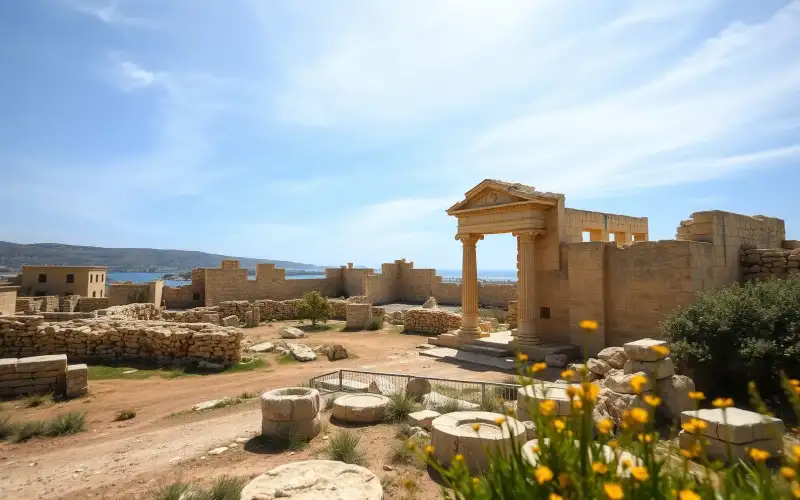
I watched a coach party of tourists trudge through the main gymnasium at Salamis in July 2023, each clutching a laminated sheet from their guide while barely glancing at the hypocaust system beneath their feet. Within thirty minutes, they were gone. Meanwhile, a couple sitting quietly on a fallen marble capital spent two hours sketching the column drums, asking the site guardian questions about the Byzantine reconstruction, and left with a notebook full of observations. The difference wasn't the price they paid—it was understanding what they'd come to see.
Salamis, the ancient Cypriot city that rivalled Alexandria in importance during the Roman period, attracts roughly 40,000 visitors annually. Yet many arrive unprepared, unclear about costs, unsure whether to hire a guide, or unaware that some of the site's most evocative corners lie just beyond the official entrance. This guide cuts through the confusion and gives you the tools to spend your time—and your money—wisely.
Current Entry Fees and What You're Actually Paying For
As of 2026, the Salamis archaeological site charges €9 per adult for general admission. Children under 12 enter free; those aged 12–18 pay €4.50. EU citizens over 60 qualify for a 50% discount (€4.50), though you'll need a passport or EU ID card to claim it. Cypriot nationals and residents pay €2. These prices have remained stable since 2021, which is unusual in Mediterranean archaeology—most sites have raised fees annually.
What does your €9 buy you? Access to a 5-hectare open-air site with clearly marked pathways, basic interpretive signage in English and Greek, and usually one or two attendants stationed near the entrance and gymnasium. There are no indoor galleries, no air-conditioned museum on-site, and no café, though there are two tavernas within 200 metres of the entrance. The site is unfenced and technically open from 9 a.m. to 5 p.m. daily, though in practice the guardians are less strict about closing time during summer months when daylight lingers until 8 p.m.
Parking is free and adequate—a gravel lot holds about 40 vehicles. If you're arriving by minibus from Famagusta (roughly 14 km south), the journey takes 25–30 minutes and costs around €3–5 depending on the service. The site is not served by regular public transport, so unless you're renting a car or joining a tour, taxi or minibus is your only option.
Guided Tours: Cost, Duration, and Real Value
Three categories of guided experience exist at Salamis. First, the official site guides—available through the Famagusta Tourism Board or directly at the entrance. These cost €50–75 for a group (up to eight people) for a 90-minute tour in English, German, or Greek. If you're travelling alone or as a couple, you'll typically be paired with other visitors; if you want a private guide, budget €75 minimum. These guides are archaeologically trained and usually hold university degrees in classics or history. I've worked with three of them over two decades, and the quality varies. Some offer rote recitation of dates; others—particularly Michalis, who's been guiding for 18 years—weave in Byzantine sources, local oral history, and architectural detail that transforms the visit.
Second, tour operators in Famagusta offer half-day Salamis packages (€40–60 per person, including transport and a guide) through hotels and online platforms. These are less flexible; you're locked into a 3–4 hour window and often bundled with other sites (St. Barnabas Monastery, the Karpas beaches). Quality is inconsistent, and the guide's expertise in archaeology varies wildly. I'd avoid these unless you have no other transport option.
Third, some hotels arrange private guides through local contacts. Expect to pay €80–120 for a 2-hour private tour. This is worthwhile if you have specific interests—Roman mosaics, Byzantine fortifications, or epigraphic evidence—and want to dive deep rather than skim the surface.
The honest assessment: if you're moderately knowledgeable about classical archaeology, a self-guided visit with a good guidebook (see below) will satisfy you. If you're new to the period or want architectural context, an official guide justifies the cost. The tour operator packages rarely do.
Self-Guided Exploration: What You Need to Know
Most visitors explore Salamis alone, and this works perfectly well if you prepare. The site layout is logical: the main entrance leads to the gymnasium and baths complex, the theatre lies northeast, and the cathedral and bishop's palace occupy the western sector. Pathways are marked, and English signage exists at major structures, though it's often weathered and occasionally inaccurate.
Before arriving, download or purchase one of two essential resources. The Salamis: Cyprus monograph by A.H.S. Megaw (1996) is the scholarly standard—dense, illustrated, and available in PDF form for €15 from academic publishers. More accessible is the Repsly guide app, which offers a walking map with audio commentary (free version available, premium €2.99). Neither is perfect, but both beat wandering blind.
Plan to spend 2–3 hours on-site if you're moving at a moderate pace. The gymnasium, baths, and theatre alone warrant 90 minutes; the cathedral and Byzantine structures another hour. If you're photographing or sketching, add another hour. The site is exposed; there's virtually no shade except near the theatre's upper tiers. Bring water—at least 1.5 litres—sunscreen, and a hat. The entrance kiosk sells bottled water for €2, which is 300% marked-up, so fill your bottle beforehand in Famagusta.
Free and Low-Cost Activities Near Salamis
The real secret to visiting Salamis affordably lies in the surrounding landscape. Within 500 metres of the archaeological site lies a network of Byzantine churches, coastal walks, and historical sites that require no admission and yield genuine archaeological interest.
The Church of St. Sergius (Agia Sergia) stands 300 metres north of the main site, accessible by a sandy path. It's a 5th-century basilica, partially excavated, with a striking mosaic floor still visible beneath protective netting. There's no fee, no guardian, and rarely any other visitors. I've sat there for hours, tracing the geometric patterns and imagining the liturgy that once echoed through the apse. The church is technically off-limits to casual visitors—the site is under conservation—but locals and archaeologists move freely, and a polite inquiry at the main Salamis entrance usually grants informal access.
The coastal path running east from the site toward the village of Engomi (about 2 km) passes through a landscape littered with Roman pottery sherds, Byzantine wall fragments, and occasionally intact roof tiles. This is free archaeology, the real thing—surface survey that any amateur can conduct. Bring a small notebook and sketch what you find. The path is easy, takes an hour, and costs nothing.
The Salamis beachfront, just south of the site, is public and free. The water is clean, the sand decent, and in summer you can swim. A small taverna, Taverna Salamis, sits on the beach and serves grilled fish and local wine for €12–18 per person. This is where local fishermen eat, not tourists, so prices are honest and portions generous. Combining a morning at the ruins with a midday swim and lunch here is the rhythm many British visitors fall into—and it's the right one.
Avoiding Overpriced Traps and Tourist Pitfalls
Several mistakes plague first-time visitors. The most common is hiring a taxi from Famagusta without negotiating a flat rate beforehand. The journey to Salamis should cost €15–20 return (with a 2-hour wait); drivers unfamiliar with the site sometimes charge €30–40. Always agree on the price in advance. If using a ride-hailing app, expect to pay €18–25 each way, which is more than a negotiated taxi but transparent.
Second, avoid the

Comments (3 comments)