
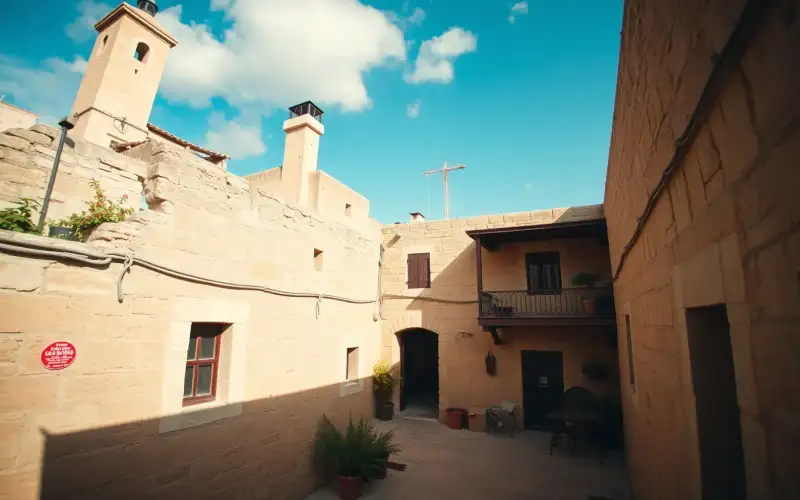
I first stumbled into the courtyard of the Palazzo del Provveditore on a sweltering Tuesday in June, completely by accident. I'd been following what I thought was a shortcut from Lala Mustafa Pasha Mosque toward the harbour, and instead found myself standing in a silent square surrounded by crumbling Venetian stonework, a single lemon tree casting shade across weathered flagstones, and absolutely nobody else around. That's when it hit me: most people who visit Famagusta's walled city spend an hour photographing the cathedral and the walls, then leave. They have no idea what's waiting in the courtyards and backstreets just metres away.
After years of driving the Karpas coastline and working my way through every corner of this peninsula, I've learned that the real magic of Famagusta isn't on the tourist map—it's in the spaces between the guidebook stops. This isn't a typical walking tour. This is what I've discovered by getting lost, asking locals in coffee shops, and spending full days wandering with no particular rush.
Before You Start: Practical Essentials
First, the logistics. The walled city is roughly 1.5 kilometres across at its widest point. You can walk the entire perimeter in about 45 minutes, but this tour is designed for a full day—ideally starting around 8 a.m., before the midday heat kicks in and before the cruise ship crowds (if any are in port) flood the main streets. Wear proper walking shoes; these are medieval streets with uneven paving, sudden drops, and stretches of rough cobblestone that will destroy flip-flops.
Bring at least two litres of water. There are only a handful of proper cafés inside the walls, and they cluster around the main squares. The backstreets have almost no shade once the sun climbs. A hat is essential. If you're staying in a villa or apartment outside the old city—which I'd recommend for a slower, more immersive stay—you'll want to park near the Lala Mustafa Pasha Mosque entrance or the Land Gate. Entry to the walled city itself is free; there are no gates or barriers, just openings in the walls where you can walk through.
The best time to explore is October through April. Summer temperatures inside the walls regularly exceed 35°C, and there's nowhere to hide. Winter mornings are crisp and clear—the light hits the stonework differently, and you'll actually want to linger.
The Walk: Seven Hidden Courtyards and What You'll Find
1. Palazzo del Provveditore – The Accidental Discovery
Start at the Lala Mustafa Pasha Mosque (the former St. Nicholas Cathedral). Face the mosque directly, then turn left down the narrow street called Istiklal Caddesi. You'll pass a small barber shop and a phone repair place. Keep walking about 150 metres, and you'll see a faded blue doorway on your left with a carved stone lintel above it. This is one of the entrances to what locals call the Provveditore courtyard, though the official name is long forgotten.
The Venetian provveditori were administrators sent from Venice to manage the island's colonial affairs. This mansion was likely built in the 15th century and served as an official residence. What strikes you first is the silence. The courtyard is perhaps 40 metres square, with a central well (now capped) and arcaded walkways on three sides. The stonework shows clear Venetian influence—look for the carved stone capitals on the columns, many of them featuring acanthus leaf designs typical of 15th-century Levantine architecture.
The ground floor rooms are largely empty or used for storage by locals, but if you look up, you'll see the second-storey windows, some with their original stone surrounds still intact. One corner room on the east side still has blue and white ceramic tiles on the floor—probably 19th-century Ottoman additions. The plaster is peeling, the iron window grilles are rusted, and it's utterly beautiful in that melancholy way that makes you want to sit down with a sketchbook for three hours.
Local tip: If the courtyard doors are open, you can walk through. If they're closed, you can see much of it from the street. Don't try to force entry; these are semi-private spaces.
2. The Lusignan House of Three Arches – Lala Mustafa Street
Head back toward the mosque and take the street running parallel to the eastern wall of the cathedral, heading toward the sea. This is Lala Mustafa Street proper (the main tourist drag). About halfway along, on your right, you'll spot a narrow alleyway marked by a faded street sign. Turn into it. You're now in one of the oldest neighbourhoods of the walled city, where the streets narrow to barely two metres wide.
Look up. The buildings here date from the Lusignan period (1192–1489), though they've been heavily modified over five centuries. You're looking for a building with three Gothic arches on what remains of its ground floor—they're partially blocked by modern concrete additions, but the stone tracery is unmistakable. This house likely belonged to a merchant family or minor nobility.
What's remarkable is how the architecture tells the story of conquest and adaptation. The original Lusignan Gothic arches remain, but above them you can see windows added during the Venetian occupation, and above those, Turkish shutters from the Ottoman period. It's all there—250 years of architectural palimpsest in a single façade.
3. The Nestorian Church Courtyard – Near the Venetian Arsenal
From the three-arch house, continue deeper into the backstreets, heading generally toward the northwestern part of the old city. You're aiming for the area near what remains of the Venetian Arsenal (now just ruins and an empty lot). Ask locals for



Comments (4 comments)