
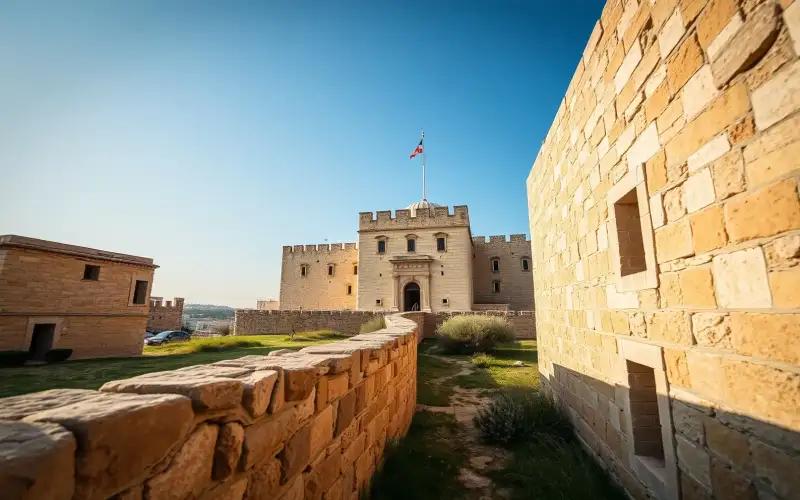
In 1570, as Ottoman forces breached Famagusta's outer defences during a 48-day siege, the Venetian garrison retreated into the castle at the city's heart. They held out for weeks in a tower that would later inspire Shakespeare's tragedy. Today, that same tower—now called Othello Castle—still dominates the skyline of the old walled city, its stone walls scarred by cannon fire and its interior largely unchanged since the Renaissance.
I first climbed those stairs in 2008, before the renovations of the 2010s, when the castle felt less like a heritage attraction and more like an archaeological site you happened to stumble into. The experience has since become more managed, more accessible, and arguably more commercial. But it hasn't lost its power. Standing on the ramparts at sunset, watching the light catch the Venetian stone, you understand why this fortress captured the imagination of writers and soldiers alike.
Overview: What Othello Castle Actually Is
Othello Castle isn't a sprawling palace or a romantic ruin. It's a compact, heavily fortified tower—technically a donjon or keep—built by the Lusignan dynasty in the 14th century and substantially reinforced by the Venetians in the 15th and 16th centuries. The castle sits within Famagusta's larger walled city, which itself is one of the best-preserved Venetian fortifications in the Mediterranean.
The Lusignan connection is crucial to understanding the site. The Lusignan family ruled Cyprus from 1192 to 1489, and they built this tower as both a defensive stronghold and a symbol of royal authority. When Venice took control of the island in 1489, they recognised the tower's strategic importance and spent decades upgrading its defences: thickening walls, adding bastions, and installing artillery positions. By 1570, when the Ottomans attacked, the tower was one of the most formidable structures in the eastern Mediterranean.
The Shakespeare connection is real but often overstated in tourist literature. There's no documented evidence that Shakespeare ever visited Cyprus or Famagusta. What we do know is that he wrote Othello around 1603–1604, roughly 30 years after the siege, and that the play's setting—a Venetian-controlled fortress under Ottoman threat—mirrors the historical reality of Famagusta. Whether Shakespeare drew inspiration directly from accounts of the siege or simply used the political geography of the moment remains debated by scholars. What matters for visitors is that the literary association is genuine enough to merit attention, and it certainly adds a layer of drama to the experience of walking these walls.
The History: From Lusignan Fortress to Ottoman Prize
The tower's earliest stones date to the 1340s, when the Lusignan kings needed a secure stronghold in their wealthiest port city. Famagusta in the 14th and 15th centuries was one of the richest cities in the Mediterranean, a major hub for spice trade and Venetian commerce. The castle served as both treasury and last refuge for the royal family if the city came under threat.
When Venice inherited Cyprus in 1489 (through the marriage of the last Lusignan queen to a Venetian nobleman), they inherited this fortress too. Over the next 80 years, Venetian military engineers transformed it. They built the outer bastions, reinforced the walls with stone quarried from the same Famagusta limestone, and installed gun emplacements designed to withstand cannon fire. The Venetians understood that medieval castles—high, narrow towers—were vulnerable to artillery. Their solution was to build lower, thicker, more angular fortifications around the original keep.
The siege of 1570–1571 tested these defences to their limits. The Ottoman fleet under Mustafa Pasha attacked in May 1570. The outer walls fell within weeks. The Venetian commander, Marcantonio Bragadin, withdrew into the castle with his remaining troops—somewhere between 1,500 and 2,500 soldiers, depending on which account you read. For 48 days they held out, launching sorties, rationing supplies, and enduring constant bombardment. When the castle finally fell in August 1571, Bragadin was executed, and Famagusta passed into Ottoman hands for the next 300 years.
The Ottoman period saw the castle repurposed as a military barracks and administrative centre. Much of what you see today—the internal divisions, the storage rooms, the narrow corridors—dates from this era. The Ottomans maintained the structure but didn't significantly alter it. When the British took control of Cyprus in 1878, they too used the castle as a garrison. It wasn't until the 1950s and 1960s that the site began to be treated as a historical monument rather than an active fortress.
What You'll Actually See Inside
The castle's interior is modest by palace standards. There are no grand halls, no decorated chambers, no throne rooms. What you get instead is a series of functional military spaces: gun emplacements, storage rooms, barracks, a small chapel, and a network of corridors and staircases. The walls are thick—in places over 2 metres—and the windows are small and defensively positioned.
The main attraction is the climb. A spiral staircase (sometimes steep, sometimes narrow) takes you up through four or five levels to the ramparts. The views from the top are worth the effort: you can see across the entire walled city, out to the harbour where the Venetian ships once anchored, and across the plains towards the Karpas peninsula. On clear days, you can see the Turkish coast to the north.
Inside the castle, informational panels (added during renovations in the 2010s) explain the history in English, French, German, and Turkish. They're helpful but fairly basic—the kind of thing you can read in 10 minutes. There's a small gift shop near the entrance selling postcards, books, and the usual tourist merchandise. A café operates seasonally (summer months mainly), selling drinks and snacks at standard tourist prices—expect to pay €3–4 for a bottle of water, €5–6 for a coffee.
The castle doesn't have a museum in the traditional sense. There are no artefacts on display, no reconstructions, no interactive exhibits. What you're experiencing is the building itself as the primary artefact. This appeals strongly to certain visitors and disappoints others. If you want to handle objects, read detailed captions, and engage with material culture, you'll find the experience thin. If you want to stand in a 14th-century fortress and imagine the siege of 1570, you'll find it powerful.
Practical Information: Tickets, Hours & Logistics
As of 2026, the castle is managed by the Department of Antiquities (part of Cyprus's Ministry of Transport, Communications and Works). Opening hours are typically 9:00 AM to 5:00 PM daily, though hours may extend to 6:00 PM in summer months (June–September). It's worth checking locally or online before visiting, as hours can shift seasonally or for public holidays.
Entrance fees for 2026:
| Visitor Type | Price (EUR) |
|---|---|
| Adult | €3.50 |
| Senior (over 60) | €1.75 |
| Child (6–12) | €1.75 |
| Child under 6 | Free |
| Student (with ID) | €1.75 |
These are among the cheapest heritage attractions in Cyprus. For comparison, entry to Kyrenia Castle (on the north coast) costs €5, and Kolossi Castle (near Limassol) costs €4. The low price reflects the castle's status as a national monument rather than a major tourist draw.
The castle is located within the walled old city of Famagusta, roughly 300 metres from the Namık Kemal Gate (the main entrance to the old city from the modern town). If you're arriving by car, park in the modern town (there's a pay car park near the gate) and walk. If you're using public transport, the local bus network (EMEL buses) connects the modern town to the old city, though service is infrequent outside summer months. A taxi from the modern town centre costs roughly €3–5.
Allow 45 minutes to 90 minutes for a visit. History buffs who want to read every panel and sit on the ramparts for a while might spend two hours. Families with young children often move faster—the novelty of climbing the tower can wear off quickly if the children aren't engaged by castles.
The Experience: Who It Suits, Who It Doesn't
Othello Castle works brilliantly for certain visitors and disappoints others. Understanding which category you fall into will help you decide whether it's worth your time.
For Solo History Travellers and Heritage Enthusiasts
If you're a British traveller in your 50s or 60s with a strong interest in Renaissance military architecture, Venetian history, or the Ottoman conquest of the Eastern Mediterranean, this castle will engage you deeply. You'll spend time reading the panels, studying the gun emplacements, imagining the 1570 siege, and standing on the ramparts absorbing the atmosphere. The literary connection to Shakespeare adds another layer—even if it's somewhat tenuous, it gives you something to think about as you climb the stairs.
The castle also works well as part of a larger Famagusta itinerary. You can combine it with walks along the Venetian walls (which take 1–2 hours), visits to the nearby St. Nicholas Cathedral, the Lala Mustafa Pasha Mosque, and the various caravanserais and merchants' houses scattered through the old city. Spent this way, a morning or afternoon in old Famagusta becomes a rich historical experience, and the castle is the centrepiece.
For Families with Younger Children
The castle is less successful with children under 10. There's no interactive content, no hands-on activities, and no storytelling designed for young minds. The climb is steep and repetitive. The views from the top are genuinely impressive, but they don't mean much to a seven-year-old who wanted to see dungeons and torture chambers (which don't exist here).
Families with teenagers who have studied Shakespeare or are interested in military history may find it more engaging. But for families with primary-school-age children, you're better off spending your time at the beaches of the Karpas peninsula or exploring the rock formations near Agia Napa.
For General Beach-Holiday Visitors
If you're in Famagusta primarily for the beach and have limited time, the castle is skippable. It doesn't offer the spectacle of Kyrenia Castle, which sits dramatically above a harbour, or the scale of Kolossi, which sprawls across a hilltop. Othello is intimate and austere. It rewards slow, attentive looking rather than quick photo stops.
Practical Tips for Your Visit
A few things to know before you go:
- Wear comfortable shoes with good grip. The spiral staircase is steep and the stone is worn smooth in places. Trainers are fine; flip-flops are not.
- Bring water. The castle has no drinking water fountain inside, and the café may not be open (especially outside summer). A 500ml bottle costs €3–4 if you buy it there.
- Go early or late. The castle can feel crowded during midday in summer, particularly if a cruise ship is in port. Early morning (9:00–10:00 AM) or late afternoon (4:00–5:00 PM) offers a quieter experience and better light for photographs.
- Check the weather. The ramparts are exposed. Strong winds are common, particularly in spring and autumn. In summer, the sun is intense—bring a hat and sunscreen.
- Don't expect toilets. There are no public facilities inside the castle. Use the facilities in the old city before entering.
- Photography is allowed. No flash, no tripods, no drones. Standard tourist photography is fine.
Visiting in Context: The Broader Famagusta Experience
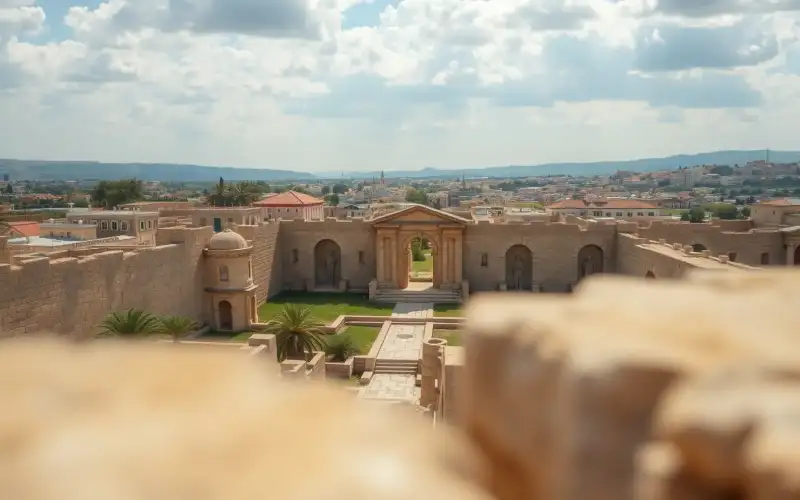
The castle works best as part of a larger exploration of Famagusta's walled city. The walls themselves, built over the course of the 16th century and now partially restored, form a complete circuit around the old city. Walking the walls (or as much of them as is accessible—some sections are still unstable) takes 1–2 hours and gives you a sense of the city's scale and the sophistication of Venetian military engineering.
Within the walls, you'll find the Cathedral of St. Nicholas (now the Lala Mustafa Pasha Mosque), a stunning example of Gothic architecture built in the 14th century. The interior is vast and atmospheric, with soaring vaults and intricate stonework. Entry is free, though modest dress is expected.
The old city also contains numerous smaller sites: the Venetian Palace, the Simizzo Caravanserai, the Palazzo del Provveditore, and various merchant houses now converted to restaurants, galleries, or shops. Many of these are accessible from the street, and wandering through the narrow lanes is itself part of the experience.
If you're spending a full day in Famagusta, a realistic itinerary might be: arrive early morning, walk a section of the walls, visit the castle (90 minutes), explore the cathedral (45 minutes), have lunch at one of the restaurants in the old city, then spend the afternoon browsing the smaller sites and enjoying coffee in one of the squares. This gives you a comprehensive sense of Famagusta's history without feeling rushed.
Final Verdict: Is It Worth Your Time?
Othello Castle is worth visiting if you're interested in military history, Renaissance Venice, or the Ottoman conquest of the Eastern Mediterranean. It's a genuine historical site with real significance, and the entry fee is negligible. The views from the ramparts are excellent, and the atmosphere is authentic—you're not walking through a reconstructed theme park but through a building that's been continuously occupied and used for over 650 years.
It's less essential if you're a casual beach tourist with limited time, or if you're travelling with young children who need more interactive engagement. But if you're the kind of traveller who spends time reading plaques, studying stonework, and imagining historical events, the castle will reward your attention. The 48-day siege of 1570 is one of the great dramas of Mediterranean history, and standing in the tower where that drama played out is a tangible connection to the past that no book or film can quite replicate.
Comments (4 comments)