
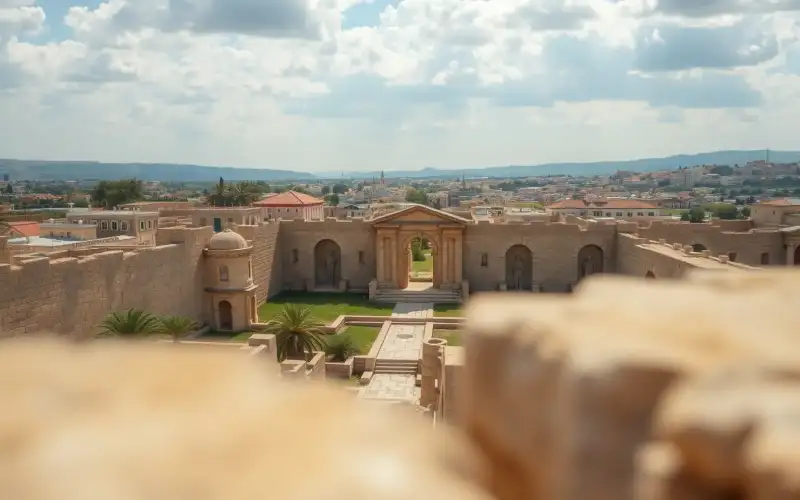
The moment you walk through the entrance gate at Salamis, you feel the weight of the place. Not oppressively—the ruins are scattered enough that you never feel crowded—but there's something about standing in a gymnasium built in the 1st century AD, surrounded by fallen marble columns and the Famagusta heat pressing down, that makes you understand why people travelled here for 2,000 years. I first visited Salamis in 2015, and what struck me then wasn't the scale, though it is vast. It was watching a British couple in their sixties sit in the theatre's upper rows at 5 p.m., barely speaking, just watching the light change across the stage. They stayed for an hour. That's what Salamis does to people—it slows you down.
The archaeological park covers roughly 5 hectares, though the actual ancient city extended much further. What you see today is the Roman and early Byzantine core, excavated mostly between the 1950s and 1980s. Three distinct areas dominate: the gymnasium complex to the north, the theatre in the centre, and the royal tombs scattered to the south and west. Each appeals differently depending on how you travel, what you want from a day, and how much heat you can tolerate. This isn't a place you rush through in two hours. Three is the minimum. Four or five is better.
What Families Love: The Gymnasium and the Puzzle of Columns
Families with children aged 8–15 tend to gravitate toward the gymnasium first, and there's logic to it. The space is open, the ground is relatively even, and there's enough to touch, climb on, and explore without feeling like you're breaking rules. The gymnasium—technically a palaestra and xystos complex—was originally built in the Hellenistic period but expanded significantly during the Roman occupation. What remains is a series of interconnected courtyards surrounded by colonnades, with about 200 Corinthian columns still standing or fallen in situ.
For children, this becomes a kind of archaeological playground. They can walk through the columns, count them, try to imagine the roofed areas, and understand scale in a way that photographs never convey. One family I spoke with in June 2026 had their 10-year-old daughter sketch the columns in a notebook. She was trying to figure out how they'd been transported from the quarry. That's the thing about Salamis—it makes you ask better questions.
The gymnasium also has the most shade, which matters. Tall columns cast long shadows in morning and late afternoon. If you're visiting with children, aim for 7–8 a.m. or after 4 p.m. The midday sun here is not negotiable; even locals avoid it. Wear a hat, bring water—two litres minimum per person—and sunscreen. The ground is mostly compacted earth with some marble paving, so trainers are essential.
Families also appreciate that the gymnasium is near the site entrance and facilities. The café serves basic coffee and cold drinks, and there are toilets. It's not luxurious, but it's there. The walk from the gymnasium to the theatre takes about 15 minutes on marked paths. To the royal tombs is another 10–15 minutes depending on which tombs you visit.
The Columned Courtyards
The main courtyard, roughly 100 metres square, would have been open to the sky. Young athletes trained here—wrestling, running, javelin throwing. The columns you see now are mostly reconstructed or fallen; the originals were likely removed during later Byzantine or Arab raids. What's remarkable is how the site's excavators left many columns lying where they fell, creating an almost sculptural landscape. You can see how heavy they are, how precisely they were cut. A single column section weighs several tonnes.
The Cold Bath House
Attached to the gymnasium's eastern side is a small bath complex, one of several at Salamis. The cold plunge bath is still visible, and you can make out the hypocaust system—the underfloor heating that Roman engineers used. Children find this genuinely interesting once you explain it. Families often spend 20–30 minutes here, tracing the flow of water, imagining the ritual.
What Couples Seek: The Royal Tombs and Solitude
Couples, particularly those in their 50s and 60s, tell a different story. They come to Salamis for the tombs, and they come to be alone. The royal necropolis at Salamis is one of the most significant in the Eastern Mediterranean. These aren't Egyptian pyramids or Anatolian rock-cut tombs—they're something quieter, more intimate. Built between the 8th and 7th centuries BC for the Cypriot royal families, they're essentially underground chambers covered by earthen mounds. Some are cut into bedrock; others are built from stone.
There are about 150 tombs in the wider necropolis, though only a handful are fully excavated and accessible to visitors. The most important are Tomb 79 (the largest), Tomb 50, and several others scattered across the southern and western sections of the park. What makes these tombs compelling for couples is partly their age—you're looking at structures built 2,700 years ago—but mostly their solitude. At any given time, you might be the only people there.
I watched a couple from Norfolk spend nearly two hours at Tomb 79 one afternoon in May. They sat on the stone bench inside the entrance chamber, barely speaking. The tomb's interior is cool—a blessed relief from the heat outside—and there's something about being inside a space that's been sealed and reopened, that's held the dead for millennia, that changes how you think. The wife told me afterward,
Comments (5 comments)