
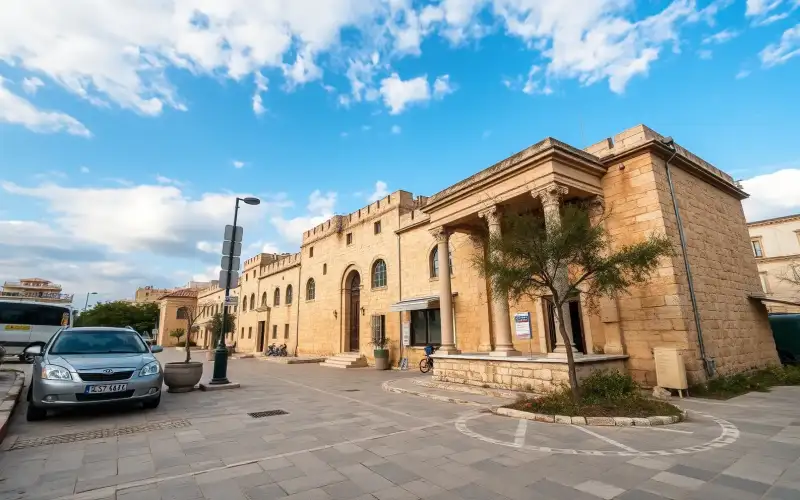
The Problem: Famagusta's Transport Paradox
I arrived in Famagusta in October 2025 without a car, something I'd done dozens of times before, yet each visit reminded me of a peculiar friction: the walled city itself is utterly walkable—medieval streets narrow enough that a determined person can cross it in thirty minutes—yet the moment you want to see Salamis (15 kilometres south) or venture into the Karpas peninsula (another 40 kilometres northeast), you hit a wall of logistics that makes car-free travel feel like swimming against a strong current.
The question isn't whether Famagusta town is navigable without wheels. It is. The question is whether the wider region—the archaeological sites, the beaches, the quieter villages that justify the journey east in the first place—remains accessible to the traveller who prefers not to rent a car. The honest answer is: partially, with significant compromise.
Why This Matters for Your Trip
British travellers in the 45-70 age bracket often tell me they prefer not to drive abroad. The reasons vary: unfamiliar road rules, anxiety about left-hand driving in a right-hand traffic system, the cost of insurance and fuel, or simply a desire to relax rather than navigate. Northern Cyprus, despite its compact size, doesn't make this preference easy. Unlike mainland Cyprus with its regular intercity buses (OSYPA, Kapardis), or Turkey with its ubiquitous dolmuş network, the transport infrastructure here is fragmented, seasonal, and requires patience.
Understanding your realistic options before arrival saves frustration. A week spent expecting frequent buses to Salamis, only to discover two departures daily at inconvenient times, can derail an otherwise excellent holiday. Conversely, knowing the limitations allows you to plan strategically: perhaps booking a private driver for specific days, combining walking with selective taxi use, or accepting that some sites require compromise.
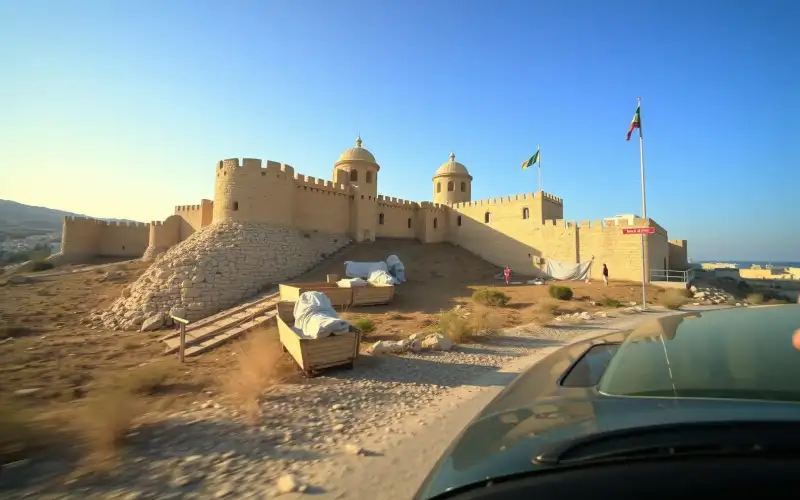
The stakes are higher than mere convenience. Salamis—with its Roman theatre, gymnasium, and necropolis—is arguably the most significant classical site in the eastern Mediterranean outside Ephesus. Missing it because of transport friction would be a genuine loss for a serious traveller.
Solution One: Master the Walled City on Foot
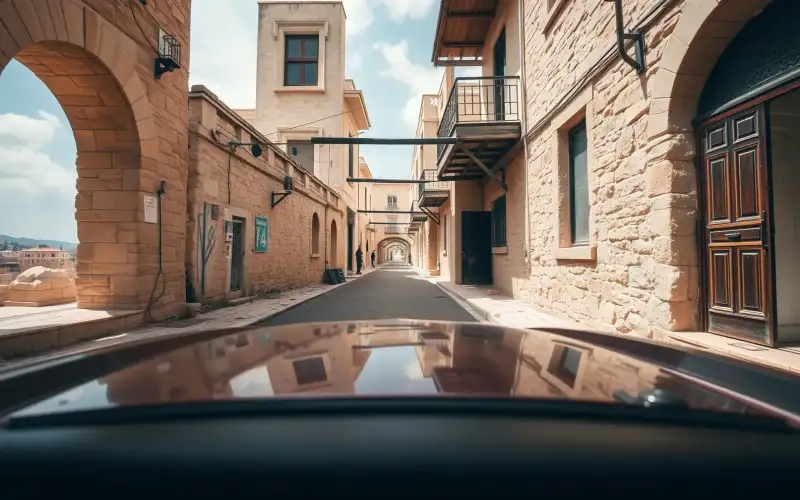
The old town of Famagusta, enclosed by Venetian walls completed in 1550, occupies roughly 0.5 square kilometres. Walking its perimeter takes forty minutes. The interior is a labyrinth of narrow streets, many closed to vehicles, which makes it ideal for pedestrians. The Cathedral of St. Nicholas (now the Lala Mustafa Pasha Mosque) sits at the heart; from there, you can reach the Citadel, the Venetian Palace, the Church of St. George of the Greeks, and numerous smaller chapels and merchant houses within fifteen-minute walks.
I've spent entire days in the walled city without feeling rushed. The rhythm suits slow travel. A morning exploring the cathedral's interior (modest entry fee, around 5 euros), followed by lunch at one of the cafés in the central square, then an afternoon climbing the walls near the Land Gate—this is realistic and deeply rewarding. The walls themselves offer views across the Mesaoria plain and, on clear days, toward the Kyrenia range.
What you sacrifice is context. Without reaching Salamis, you're missing the Roman world that shaped Famagusta's later prosperity. Without the Karpas, you miss the quieter, less-developed landscape that preserves something of pre-modern Cyprus. But within the walled city itself, you have genuine substance: Venetian military architecture, Ottoman additions, layers of Christian and Islamic worship, and the physical traces of a city that mattered in Mediterranean trade for five centuries.
Solution Two: Dolmuş Minibuses—Cheap but Unreliable
The dolmuş system in Northern Cyprus operates on principles that confound newcomers accustomed to British buses. These are shared minivans (typically 12-14 seats) that depart when full, not on schedule. There's no printed timetable in the conventional sense. Instead, you go to the dolmuş stand (in Famagusta, this is near the Lala Mustafa Pasha Mosque in the old town), ask when the next minibus to Salamis or Nicosia departs, and wait.
The wait can be five minutes or fifty, depending on season and day of week. Weekday mornings (especially Tuesday to Thursday) tend to be busier. Summer sees more frequent departures. Winter—particularly January and February—can mean long gaps between vehicles. The cost is negligible: a journey to Salamis costs around 3 euros per person; to Nicosia, roughly 5 euros.
I tested this system in October 2025. A minibus to Salamis arrived after twelve minutes. The driver stopped at the entrance to the archaeological site (near the museum), then continued to Varosha's perimeter before returning. Total journey time: twenty minutes each way. The return journey took forty-five minutes because the driver waited for passengers at several points. This unpredictability is the system's defining characteristic.
For Salamis specifically, dolmuş is viable if you're flexible. For the Karpas peninsula, it becomes problematic. Minibuses to Dipkarpaz (the peninsula's main town) depart less frequently—often only one or two daily—and the journey takes ninety minutes. Missing a departure means potentially waiting hours for the next.
Solution Three: Taxis—Expensive but Convenient
Famagusta has licensed white taxis with meters. From the airport in Larnaca (the nearest international airport, 90 kilometres southwest), a taxi to Famagusta costs approximately 120-150 euros—steep, but viable if shared between two or three people. Within Famagusta town, short journeys cost 5-8 euros.
For day trips, taxis become expensive. A round trip to Salamis (30 kilometres total) costs roughly 50-70 euros, depending on waiting time. If you arrange the taxi to wait while you explore the site (typically 2-3 hours), expect to pay 80-120 euros total. This is manageable for a couple but steep for a solo traveller.
The Karpas peninsula presents a different challenge. A taxi from Famagusta to Dipkarpaz (40 kilometres) costs around 60-80 euros one-way. If you want a return journey with waiting time, budget 180-250 euros. This is where car rental (roughly 30-40 euros daily) becomes economically rational.
Taxis are reliable and comfortable. Drivers are accustomed to tourists and speak adequate English. You avoid the uncertainty of dolmuş timing. The trade-off is cost and a sense of being somewhat isolated—you're not mixing with locals, experiencing the shared minibus culture, or stretching your budget as far as it might otherwise go.
Solution Four: Hybrid Approach—Selective Car Hire
A practical compromise: spend most of your stay in Famagusta, exploring the walled city on foot and using dolmuş for local journeys, then rent a car for one or two specific days to visit Salamis, the Karpas, or both. Car rental in Famagusta costs 25-40 euros daily for a basic hatchback (2026 rates), with fuel adding another 15-20 euros per day. This works out cheaper than multiple taxi journeys and gives you flexibility.
The challenge is driving itself. Northern Cyprus drives on the left (inherited from British rule), but road standards are variable. Main routes are adequate; minor roads can be rough. Signage is inconsistent. If you're genuinely uncomfortable driving abroad, this doesn't solve your problem. But for travellers with some experience, it's manageable.
Expert Tips for Car-Free Visits
Several practical strategies reduce the friction of car-free travel:
- Stay near the old town. Hotels within or immediately adjacent to the walled city (such as the Altın Kıbrıs or smaller guesthouses) eliminate the need for transport just to reach the main sights. Budget 40-80 euros nightly for decent mid-range accommodation.
- Visit Salamis on a dolmuş morning. Arrive at the minibus stand by 9 a.m. on a weekday. Departures are most frequent then. Spend 2-3 hours at the site, then catch a return minibus by early afternoon.
- Accept that the Karpas requires compromise. Either rent a car for that day, book a private driver (ask your hotel; expect 80-120 euros for a full day), or skip it entirely. Don't spend your holiday frustrated by transport logistics.
- Use taxis for evening meals. Restaurants worth visiting often lie outside the walled city. A 5-euro taxi ride is worth the convenience and safety, especially after dark.
- Download offline maps. The walled city is easy to navigate, but having a map of Famagusta town (outside the walls) on your phone prevents the need for constant internet searches.
What You're Realistically Missing
A car-free visit to Famagusta is entirely possible. A car-free exploration of the wider region—Salamis, the Karpas, smaller archaeological sites scattered across the peninsula—is difficult without accepting significant compromises in time, cost, or both.
Salamis itself is reachable by dolmuş, but the timing requires flexibility. The Karpas peninsula (Dipkarpaz, Agia Trias, the beaches at Cape Apostolos Andreas) is practically inaccessible without a car or a full day's taxi hire. Smaller sites—the ruins at Enkomi, the medieval castle at Kantara—fall into the same category.
This isn't a failure of the region. It's a reflection of how Northern Cyprus developed. Tourism infrastructure follows car-based assumptions. Most visitors rent vehicles. Public transport exists primarily for locals commuting between towns, not for tourists making circular day trips.
The Honest Conclusion
Can you visit Famagusta without a car? Yes, comfortably. Can you explore the broader region without one? Partially, with planning and flexibility. Can you do both without frustration? Probably not.
The walled city rewards slow, pedestrian exploration. Salamis is reachable by minibus if you're patient. The Karpas peninsula and its scattered sites require either a rental car, a private driver, or acceptance that they'll remain unseen. For many travellers, this is a reasonable trade-off. The walled city and Salamis alone justify the journey east, and both are accessible without wheels if you plan carefully.
My advice: be honest with yourself about what matters. If archaeological depth is your priority, a car rental for 1-2 days is worth the cost and mild stress. If you're content with the walled city and a dolmuş trip to Salamis, car-free travel is entirely feasible. Either way, arrive with realistic expectations, and you'll have a far better experience than if you expect a level of transport convenience that simply doesn't exist here.
Comments (3 comments)