
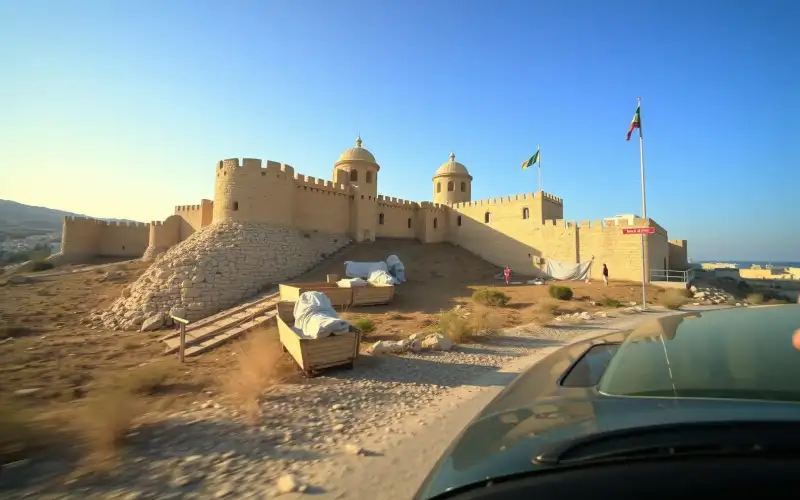
I watched a couple from Cheltenham sit in their hired Nissan Micra for twenty minutes at the Famagusta checkpoint, papers spread across the steering wheel, utterly bewildered. The woman kept asking the same question—"But we're just driving to Salamis"—as if geography might somehow exempt them from the realities of a border crossing. They hadn't printed their hire car documents. They hadn't informed their insurance company. They'd simply assumed that because they could see the ruins from the southern side, the drive north would be straightforward. It wasn't. By the time they were turned back, they'd lost an afternoon and their holiday mood entirely.
That encounter, three years ago now, taught me something crucial about crossing into Northern Cyprus: the checkpoint isn't complicated, but it demands respect and preparation. The Famagusta crossing—officially the Deryneia checkpoint—is the most direct route from the Republic into the Karpas peninsula and the northern coast. It's also the gateway that catches unprepared travellers off guard more often than not.
Understanding the Checkpoint Landscape
There are four crossing points between the Republic and Northern Cyprus: Ledra Street in Nicosia (pedestrians only), Agios Demetrios near Larnaca (rarely used), the Astromeriitis crossing in the Troodos foothills (very remote), and the Deryneia checkpoint in Famagusta district. For anyone driving from Famagusta town or the surrounding coast, Deryneia is the only realistic option. It's a ten-minute drive from Famagusta old town, roughly twenty minutes from Paralimni, and it's the busiest crossing for vehicles.
The checkpoint itself sits in a narrow corridor of no man's land between the UN buffer zone and the northern border. You'll see the Republic's flag and barriers on the southern side, then a stretch of road with nothing but empty fields and a few abandoned buildings, then the Turkish flag and northern checkpoints ahead. It's an eerie passage, and it feels longer than it is—perhaps a kilometre at most, but psychologically it stretches.
The crossing operates daily from 6:00 AM to midnight. These hours have remained consistent since 2023, though I'd always check current timings before departing, as they can shift seasonally. Summer peak hours—roughly 10:00 AM to 4:00 PM—see queues of thirty minutes to an hour. Early morning or late evening crossings are typically faster. If you're driving in July or August, factor in extra time and patience.
The Documentation You Actually Need
This is where most travellers stumble. You need three specific documents, and missing even one will halt you at the checkpoint.
Hire Car Documentation
First, your hire car papers. Not a photo of them on your phone. Physical printed documents. When you collect your car from a Republic rental company—Hertz, Europcar, Budget, or any local firm—you'll receive a contract and a vehicle registration document. The registration is the critical one. It's a multi-page booklet, usually blue or green, with vehicle details and your name as the authorized driver. Keep this in your vehicle at all times while driving north. At the checkpoint, officers will ask to see it. They'll verify that the car is registered in the Republic and that you're the named driver (or a named driver if multiple people are listed). If you've rented under someone else's name and you're driving, that person must accompany you or you'll be turned back.
Some rental companies provide a special "Green Card" for Northern Cyprus travel—a document proving third-party liability insurance is valid north of the border. Not all companies offer this automatically. When collecting your car, explicitly ask: "Do you have a Green Card for Northern Cyprus?" If they say yes, take it. If they say no or seem uncertain, ask them to contact their insurer. This card is technically separate from your main hire agreement, and it's your proof that you're legally insured to cross.
Your Passport and Travel Documents
Bring your British passport. The checkpoint officers will check it against your hire car documents to confirm you're the authorized driver. They're not typically concerned with entry stamps or visa status—you're a British citizen moving between two parts of the same island—but they do verify identity. I've seen travellers delayed because their passport didn't match the name on the hire agreement (perhaps a married name discrepancy or a nickname used in booking). Bring any documentation that clarifies the connection if there's any ambiguity.
If you're not the main driver on the hire contract, bring a letter of permission from the person who is. It doesn't need to be formal, but it should state that you're authorized to drive the vehicle. This won't always be requested, but it smooths things considerably if questions arise.
Checkpoint Declaration Form
As you approach the checkpoint, you may be handed a declaration form. It's straightforward—your name, vehicle registration, and a statement that you're temporarily importing the vehicle. Complete it clearly and honestly. If you're carrying more than €10,000 in cash, declare it. If you're carrying restricted items (certain plants, large quantities of alcohol or tobacco), declare those too. The form is a formality for most travellers, but it's the official record of your crossing.
Insurance: The Invisible Requirement
This is where hire car companies often create confusion, and where British travellers frequently go wrong. When you hire a car in the Republic, your third-party liability insurance is valid in the Republic and EU member states. Northern Cyprus is neither. It's a separate territory with its own insurance requirements.
Your hire car contract will have a section on territorial coverage. Read it carefully. Some companies automatically extend coverage to Northern Cyprus at no extra cost. Others require you to purchase an additional "Green Card" or "Northern Cyprus extension" at a cost of roughly €15–€25 per day. A few companies refuse to allow their vehicles to cross at all, though this is increasingly rare.
When you collect your car, ask directly: "Is this vehicle insured for Northern Cyprus?" If the answer is "yes," ask them to confirm it in writing on your contract. If it's "no" or "you'll need to purchase additional coverage," do it immediately. Don't assume you're covered. Don't think your UK travel insurance will substitute. It won't. You're driving a foreign-registered vehicle in a territory with its own traffic laws and insurance requirements. You must be properly insured.
The checkpoint officers won't ask to see your insurance certificate, but if you're stopped by traffic police in the north and you can't produce proof of valid coverage, you'll face fines and potentially a vehicle impound. It's not worth the risk.
What to Expect at the Checkpoint Itself
The process is orderly, if occasionally slow. As you approach from the south, you'll see a barrier and a small booth. Stop when directed. An officer will ask for your documents: passport, hire car registration, and declaration form. They'll examine them, possibly ask a few questions, and then either wave you through or ask you to pull over for a more thorough check.
The thorough check is rare but does happen. Officers may open the boot, check the vehicle registration number matches the documents, or ask you questions about the purpose of your visit. "Tourism" is a perfectly acceptable answer. "I'm driving to Salamis ruins" or "I'm staying in Kyrenia for a week" are straightforward reasons. Don't volunteer excessive information or appear evasive. Be polite, patient, and honest.
The entire process typically takes five to fifteen minutes per vehicle, depending on traffic and the thoroughness of the inspection. During peak hours, you may wait thirty minutes or more just to reach the booth. During quiet periods, you might be waved through in under five minutes.
One practical note: the checkpoint is cash-only for any fees. There are no ATMs immediately at the crossing, though there are petrol stations and shops just north of the checkpoint where you can withdraw cash. If you're crossing early in the morning, ensure you have some Turkish Lira (TRY) or euros on hand. Most businesses in the north accept euros, but having some local currency is helpful.
The Drive North: What Changes
Once you cross, you're in Northern Cyprus. The road quality is generally good, though less uniformly maintained than the Republic's roads. Speed limits are posted in kilometres per hour. The speed limit on main roads is typically 90 km/h, in towns 50 km/h, and on the motorway sections 110 km/h. Traffic police do enforce these, and speeding fines are substantial.
Petrol stations are frequent, particularly around Kyrenia and Famagusta. Fuel is slightly cheaper than in the Republic. Tolls don't exist on northern roads. Parking in towns is generally free or very inexpensive (a few Turkish Lira per hour).
The landscape changes subtly but noticeably. The north has a quieter, less developed character. Roads wind through villages that feel genuinely lived-in rather than tourist-oriented. The Karpas peninsula, which stretches eastward from Famagusta, is particularly remote and beautiful—narrow roads, scattered hamlets, and long stretches of empty coastline. This is where I spend my quietest painting mornings, usually in early spring when the peninsula is nearly empty.
Return Crossing and Onward Planning
Returning to the Republic is essentially the reverse process. You'll approach the northern checkpoint, present your documents again, and then cross into the buffer zone and the Republic's southern checkpoint. The return crossing is usually slightly faster than the northbound crossing, as fewer vehicles tend to travel south than north.
One important detail: your stay in the north is typically limited to fifteen days per entry. If you're planning a longer visit, you'll need to exit and re-enter. Most travellers don't stay more than a few days, so this isn't usually a constraint. But if you're planning an extended exploration of the Karpas peninsula, be aware of this limitation.
Also, be aware that petrol purchased in the north won't be recognized by Republic petrol stations if you try to return with a full tank and claim a refund. The fuel systems are separate, and there's no reciprocal agreement. Don't overfill your tank before crossing back south.
Practical Checklist Before You Cross
I've learned the hard way that a checklist prevents the kind of frustration that couple from Cheltenham experienced. Before driving to the checkpoint, verify the following:
- Hire car registration document is in the vehicle (not photographed, but physical)
- Passport is accessible and current
- Insurance coverage for Northern Cyprus is confirmed in writing on your hire contract or as a separate Green Card
- You have some cash (euros or Turkish Lira)
- Fuel tank is adequate for your intended drive north
- You've checked current checkpoint operating hours
- If you're not the main driver on the contract, you have written permission from the person who is
That's genuinely all you need. It seems like a lot until you've done it once, and then it becomes straightforward. The checkpoint isn't designed to be difficult; it's designed to verify that you're legally entitled to take a Republic-registered vehicle across the border and that you're properly insured. Once those things are confirmed, you're through.
A Final Thought on the Crossing
The checkpoint represents something larger than a border formality. It's a physical reminder that Cyprus is a divided island, that the north and south are administratively separate, and that movement between them requires deliberate action and documentation. It's not a barrier designed to frustrate tourists—it's a practical necessity given the island's political complexity.
That said, once you cross, you'll find that the division feels less significant than you might expect. The landscape is continuous. The people are warm. The history is shared, though interpreted differently. The drive to Salamis takes you through villages where Turkish and Greek Cypriot families lived alongside each other for centuries. The Karpas peninsula stretches eastward with an almost untouched beauty that neither the north nor the south has managed to fully develop or commercialize.
The crossing itself is just a practical hurdle. But it's one worth clearing properly, with documents in order and expectations set correctly. Do that, and you'll have access to some of the island's most genuinely unhurried corners—the kind of places where slow travel actually means something.
Comments (4 comments)