
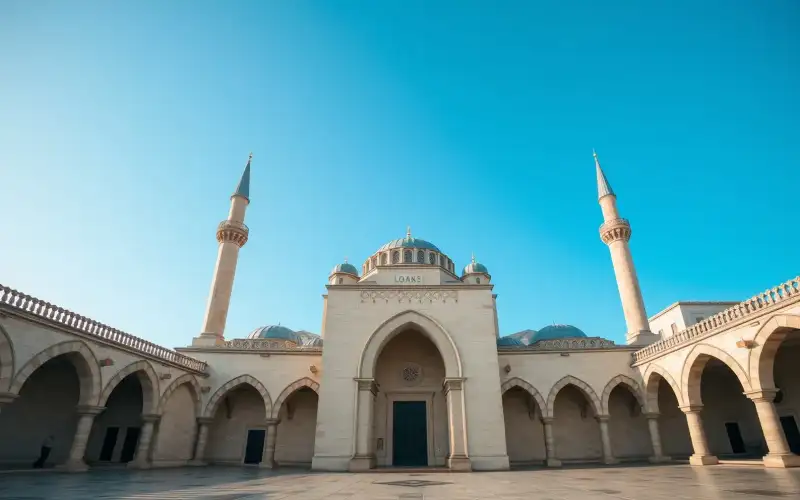
I first saw the Lala Mustafa Pasha Mosque on a November afternoon when the light was turning the honey-coloured stone almost amber. The Gothic spire—still there, defiant and strange—caught the sun at an angle that made it seem to float above the walled city's terracotta roofscape. A muezzin's call drifted across the ramparts, and for a moment, the building seemed to hold both its histories at once: the medieval Christian prayer that once echoed through its vaults, and the Islamic devotion that has inhabited it for nearly 450 years. This is not a place you can understand by reading about it. You have to stand inside it.
The Lala Mustafa Pasha Mosque sits at the heart of Famagusta's walled old town, on Lala Mustafa Pasha Street, roughly 200 metres from the Citadel's main gate. It is the largest and most architecturally significant religious building in the eastern Mediterranean's Venetian-era cities, and it remains one of Cyprus's most compelling monuments to the island's fractured, layered past.
A Building That Refuses to Choose
The structure began as the Cathedral of Saint Nicholas in the 14th century, during the Lusignan period when Famagusta was a thriving Christian port and one of the wealthiest cities in the eastern Mediterranean. The Venetians, who took control of Cyprus in 1489, expanded and fortified it. They added the buttresses you see today, strengthened the walls, and refined the interior. The cathedral was consecrated in 1524, just as Venetian power in the region was beginning to fracture under Ottoman pressure.
When the Ottomans conquered Famagusta in 1571 after a brutal 11-month siege, the building's fate shifted. Rather than destroy it—as happened to many Christian structures across the island—the Ottoman authorities converted it into a mosque. The name Lala Mustafa Pasha comes from the Ottoman general who led the siege. He was a revered figure in Ottoman military history, and naming the mosque after him was an act of commemoration and territorial claim.
What makes this conversion so architecturally fascinating is that very little was demolished. The Ottomans removed the altar, whitewashed the Christian iconography, blocked some windows, and added Islamic calligraphy. They inserted a wooden minbar (pulpit) and a mihrab (prayer niche facing Mecca). But the Gothic ribbed vaults remain. The pointed arches stay. The flying buttresses stand untouched. You can still trace the geometry of medieval Christian intention underneath the layers of Islamic adaptation.
Walking Through Seven Centuries
As you enter through the main western door—the original Gothic entrance—your eye is immediately drawn upward. The nave stretches 45 metres long and 24 metres wide, with a ceiling that rises to about 25 metres at its apex. The ribbed vaulting is the real showpiece: each section of vault is articulated with stone ribs that spring from slender pillars, creating a sense of weightlessness that Gothic architects spent generations perfecting. In the afternoon light, these ribs cast sharp shadows that shift across the whitewashed walls like the hands of a slow clock.
The side aisles are narrower and lower, creating a sense of progression toward the central space. Notice the flying buttresses on the exterior—these are not decorative. They transfer the weight of the vault outward and downward, allowing the walls themselves to be thinner and the windows larger than would otherwise be possible. This was revolutionary engineering in the 14th century.
The Ottoman modifications are visible but not intrusive. The mihrab—the niche indicating the direction of Mecca—is positioned on the eastern wall, slightly off-centre because the building's original orientation was Christian (east-west, with the altar at the east end). Islamic calligraphy in elegant Ottoman script runs along the upper walls. Some of the original stained-glass windows have been replaced with plain glass or blocked entirely, which changes the interior light considerably but also makes sense: Islamic tradition discourages figurative imagery, and the original Christian windows would have depicted saints and biblical scenes.
The minbar, a wooden pulpit with a narrow staircase, dates from the Ottoman period and is a fine example of 16th-century craftsmanship. It sits to the right of the mihrab, as is customary in mosque design. The floor is largely bare stone, with some carpets laid out for prayer.
Practical Information for 2026 Visits
The mosque remains an active place of worship, which is essential context for any visit. It is not a museum. People come here to pray, and their spiritual practice takes absolute priority over tourism.
Opening hours and access: The mosque is generally open to visitors outside of the five daily prayer times. These are approximately dawn (around 6:15 a.m. in summer, 7:30 a.m. in winter), midday (around 1:00 p.m.), afternoon (around 4:15 p.m.), sunset (around 6:45 p.m. in summer, 5:15 p.m. in winter), and evening (around 8:00 p.m.). During Ramadan, timings shift, and access may be more restricted. There is no formal admission fee, though a donation box is present. Check locally or ask at your hotel for current prayer times, as these vary slightly with the season.
Dress code: This is not negotiable. Women should cover their shoulders, chest, and knees. A headscarf is required for women; many visitors bring their own, but the mosque sometimes has spare scarves available. Men should wear trousers and cover their shoulders. Avoid transparent or revealing clothing. Shoes must be removed before entering the prayer hall; there is a shoe rack just inside the entrance.
Photography: Photography inside the mosque is generally not permitted during prayer times. Outside prayer times, ask a caretaker or staff member first. Some areas may be off-limits. Respect these boundaries without argument.
Behaviour: Speak quietly. Do not walk in front of people who are praying. Do not sit or lean on the prayer carpets. If you are not Muslim, do not enter the mihrab area or touch the minbar. Do not eat, drink, or chew gum inside the building.
The best time to visit is mid-morning (around 10:00 a.m. to noon) or mid-afternoon (around 2:30 p.m. to 4:00 p.m.), when prayer times are typically finished and the next prayer is still some hours away. Friday is the main prayer day for Muslims, so expect larger crowds and potentially restricted access on Friday afternoons.
The Wider Context: Famagusta's Venetian Heritage
The Lala Mustafa Pasha Mosque cannot be understood in isolation. It sits within the Famagusta walled city, a UNESCO World Heritage Site that contains roughly 50 other significant medieval and Venetian buildings. The city walls themselves, constructed by the Venetians and reinforced by the Ottomans, stretch for nearly 3.5 kilometres and remain among the most complete surviving examples of 16th-century military architecture in the Mediterranean.
Within walking distance of the mosque, you'll find the Citadel (also called the Othello Castle, though this attribution is historically dubious), the Church of Saint George, several caravanserais (merchant inns), and the remains of the Venetian palace. The whole walled city is best explored on foot, and a morning or afternoon can easily be spent moving between these sites.
The broader story is one of conquest and adaptation. The Venetians arrived in 1489 as traders and administrators. They built fortifications, expanded the harbour, and created a cosmopolitan trading hub where Christian, Muslim, and Jewish merchants coexisted—not always peacefully, but with a degree of pragmatism that characterised Mediterranean commerce. The Ottoman conquest in 1571 was brutal, but what followed was a different kind of coexistence. The mosque's survival as a converted cathedral, rather than a demolished ruin, suggests a certain Ottoman pragmatism about the built environment.
What You'll See: A Room-by-Room Breakdown
The main prayer hall is what most visitors see. The central nave is where the bulk of worshippers stand during prayer. The side aisles are less densely used, and visitors are often directed here if they arrive during quieter periods. The acoustics are excellent—the Gothic vaults carry sound in a way that feels almost musical.
The eastern end of the building, where the mihrab is located, is the most sacred space in Islamic terms. Non-Muslims should not approach this area closely, and certainly not during prayer times. The mihrab itself is a recessed niche, typically decorated with tilework or calligraphy, and it marks the direction of Mecca (which from Famagusta is roughly southeast, hence the slight offset from the building's original Christian orientation).
The western end, where you enter, retains some of the original Gothic character. The main door is framed by pointed arches and decorated stonework. Above it, the interior is lighter and more open than the eastern end, which creates a subtle psychological progression as you move deeper into the building.
The upper galleries, if accessible, offer a different perspective on the vaulting and allow you to appreciate the engineering more fully. However, access to upper levels is often restricted, especially during prayer times or if structural work is ongoing.
Visiting Etiquette: A Detailed Guide
Respectful visiting is not just about following rules; it's about understanding that you are entering a space of living faith, not a historical curiosity shop. The people who pray here are not performing for tourists. They are engaged in one of the five pillars of Islam.
Before you enter, pause. Look at the shoes piled by the entrance. Observe whether people are praying. If the prayer hall is busy, consider waiting outside or visiting at a quieter time. There is no virtue in pushing through a crowded prayer session to tick a box on your itinerary.
When you remove your shoes, place them neatly with the others. Do not leave them in the middle of the entrance where they will obstruct people entering and leaving. Once inside, move slowly and deliberately. Keep your eyes lowered slightly rather than staring around as if you are in a cathedral museum (which, technically, this building once was, but is no longer).
If you want to sit and observe, find a spot away from the prayer carpets and sit quietly. The experience of simply being in the space, feeling the light change, hearing the occasional muezzin's call from the minaret, is often more valuable than any guided tour could be.
If you have questions, ask a caretaker or staff member politely. Many speak English. If they are busy, come back later or ask at the Famagusta Tourism Information Centre, which is located near the Citadel.
Beyond the Building: The Minaret and Exterior
The minaret, the tall tower from which the call to prayer is broadcast, is one of the mosque's most distinctive features. It was added by the Ottomans and rises from the southwestern corner of the building. It is not open to the public, but it is worth walking around the exterior of the mosque to see how it integrates (or fails to integrate) with the Gothic architecture. The contrast is stark and, in its own way, rather beautiful—a visual representation of the building's dual identity.
The exterior walls show clear evidence of their age. Stones are weathered, some are patched, and graffiti from various periods is visible. This is not a restored, sanitized heritage site. It is a working building that has survived wars, sieges, earthquakes, and centuries of use. That patina of history is part of its authenticity.
Practical Logistics: Getting There and Spending Time
The mosque is located in the heart of the walled city, roughly 500 metres from the main entrance gate (the Land Gate). If you are staying in Famagusta town, it is walkable. The walled city is compact—you can cross it on foot in about 15 minutes. Street signage is minimal, but the minaret is visible from most points within the walls, so you can navigate by sight.
There is no public transport within the walled city itself. If you are coming from outside Famagusta (say, from Ayia Napa or the Karpas peninsula), you'll need to either drive to the walled city and park near the gates, or take a local taxi. Parking is limited and can be challenging in summer.
Plan to spend 30 to 45 minutes inside the mosque itself, depending on how long you sit and observe. Add another hour or two if you want to explore the wider walled city. Many visitors combine a visit to the mosque with a walk around the walls, a visit to the Citadel, and lunch at one of the small restaurants or cafés scattered throughout the old town.
The Experience: What It Feels Like
Standing inside the Lala Mustafa Pasha Mosque on a quiet afternoon, with light streaming through the windows and the space largely empty, you become aware of the building's acoustic properties in a new way. Every footstep echoes slightly. The air feels cool, even in summer. The stone seems to absorb sound and history in equal measure.
If you are there during prayer time—and if you position yourself respectfully in a side aisle—you'll witness something quite different. The space fills with people, the rhythm of prayer creates a kind of collective breathing, and the building suddenly feels alive in a way that no amount of architectural analysis can convey. The Gothic vaults that were designed to amplify Christian chant now carry Islamic devotion. The building adapts, as it has adapted for 450 years.
This is ultimately what makes the Lala Mustafa Pasha Mosque so compelling. It is not a frozen moment in time. It is a living space where history is not something you read about in a guidebook; it is something you feel in the stone, hear in the acoustics, and witness in the faces of people who come here to pray.
Final Thoughts: Why It Matters
The Lala Mustafa Pasha Mosque is often overshadowed by more famous Cypriot sites—Kyrenia Castle, the Bellapais Abbey, the painted churches of the Troodos Mountains. Yet it may be the single most important building for understanding Cyprus's complex religious and cultural history. It is a place where conquest and coexistence are literally built into the walls. Where medieval Christian engineering serves Islamic prayer. Where a Gothic cathedral became a mosque, and neither identity was entirely erased.
For British travellers seeking to understand the less-touristy, deeper layers of Cyprus—particularly the east of the island, which has been less developed and less visited than the south and west—the mosque offers a kind of key. It opens doors to questions about how communities adapt, how buildings survive, and how history is not something that happened in the past but something that continues to unfold in the present.
Visiting respectfully, with an open mind and a willingness to sit quietly and observe, may teach you more about Cyprus than a dozen other sites combined.
Comments (4 comments)