
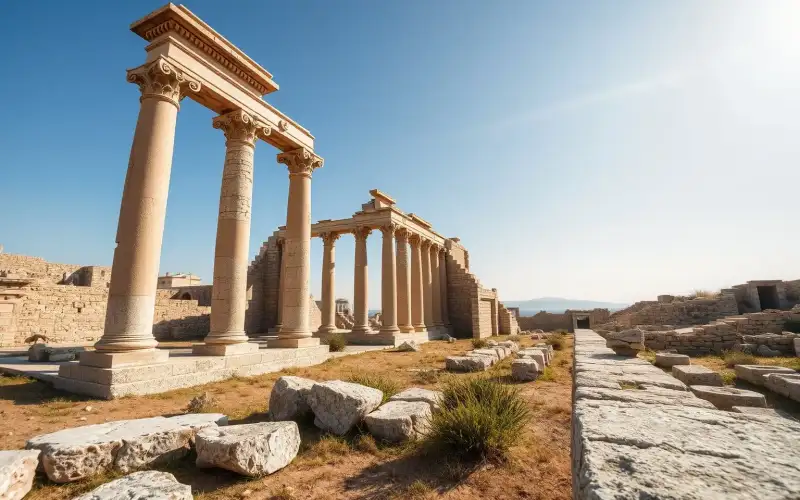
I stood at the edge of the gymnasium at Salamis one March morning, watercolour pad balanced on my knee, watching the light catch the marble columns as they emerged from shadow. A shepherd moved his flock through the ancient portico—an image that could have belonged to any century in the last two thousand years. This is what makes Salamis extraordinary: it refuses to perform for tourists. The site sprawls across 150 acres of coastal scrubland near Famagusta, largely undisturbed by the development that has transformed other parts of Cyprus. For British travellers accustomed to the manicured grandeur of Mediterranean archaeology, Salamis offers something rawer, more intimate, and infinitely more rewarding.
The ancient city of Salamis was founded in the 11th century BCE by Cypriot settlers, flourished as a Greco-Roman port, and was devastated by earthquakes and Arab raids in the 7th century CE. What remains is a palimpsest of that long history—columns rising from grass, mosaics emerging from excavation, the foundations of temples and public buildings laid bare. Unlike Kourion or Paphos, Salamis has resisted heavy reconstruction. You won't find pristine marble facades or theatrical lighting. Instead, you'll find the raw archaeology of a city that was genuinely important, genuinely prosperous, and genuinely abandoned.
The Site at a Glance: What You're Walking Into
Salamis occupies roughly 150 acres on a peninsula jutting into Famagusta Bay. The archaeological park is divided into several major zones, each requiring different amounts of time and attention. The entrance is near the modern village of Salamis, about 6 kilometres north of Famagusta town centre. Parking is straightforward—a small gravel car park sits adjacent to the ticket office and a modest café.
Entry costs 15 euros per person (2026 rates). The site is technically open year-round, but practically speaking, opening hours are 9 a.m. to 4 p.m. in winter (November–March) and 9 a.m. to 5 p.m. in summer (April–October). There is no entry fee for children under six. The site is not heavily staffed, and there are no guided tours unless you arrange one privately through your hotel or a tour operator in Famagusta.
The terrain is mostly flat, but uneven. Paths between major monuments are well-trodden and obvious, but there is no formal trail system. Bring sturdy walking shoes, a hat, and at least two litres of water. The café at the entrance stocks basic refreshments but not much beyond coffee and fizzy drinks. There is one shaded shelter near the gymnasium, but otherwise, the site offers minimal protection from the sun. In summer, the heat can be brutal—I'd recommend arriving by 8:30 a.m. and leaving by 1 p.m., then returning in late afternoon if you have the stamina.
Option A: The Half-Day Focused Visit (3–4 Hours)
Best For: Travellers with Limited Time, Families with Young Children, Those Preferring a Lighter Pace
If you have only a morning or afternoon, focus on the central monuments. This approach gives you a genuine sense of Salamis without overwhelming exhaustion or decision fatigue. Most visitors can see the essential sites in three to four hours at a leisurely pace.
The Gymnasium and Palaestra. Start here—it's the most visually impressive monument and sits near the entrance. The gymnasium was built in the Roman period and is remarkable for its scale and preservation. Two rows of marble columns still stand, framing what was once a large open courtyard where athletes trained. The columns are Corinthian, fluted, and some reach heights of seven metres. Walking between them, you get a visceral sense of Roman grandeur. To the north lies the palaestra, a smaller exercise yard surrounded by changing rooms and storage areas. Spend 45 minutes here. Bring a sketchpad if you're inclined to draw—the interplay of shadow and stone is endlessly compelling.
The theatre sits immediately west of the gymnasium. It's smaller than you might expect—capacity around 15,000—but beautifully positioned overlooking the bay. The stage building is largely ruined, but the seating areas (cavea) are recognisable. Climb to the upper tiers for views across the site and the coast. Twenty minutes here is sufficient unless you want to sit and contemplate the view, which I recommend.
The Basilica. Walk south from the theatre, following the main path. The basilica is a Byzantine structure dating to around the 5th century CE. It's a three-aisled basilica with an apse at the east end, and the columns that separated the aisles still stand. The floor was once decorated with mosaics—fragments remain, protected under glass in places. This monument is less visually dramatic than the gymnasium, but it's historically crucial: it shows how Salamis adapted to Christianity after Roman rule. Allow 20–30 minutes.
The Necropolis. If you have time remaining, walk north from the gymnasium toward the necropolis. This is a vast burial ground with rock-cut tombs and stone sarcophagi scattered across a hillside. It's haunting and atmospheric—fewer tourists venture here, and the silence is palpable. You can spend as little as 15 minutes or as long as an hour. I often return here at the end of the day when the light turns golden and the site feels truly abandoned.
Logistics for the Half-Day Visit
- Arrive early (8:30 a.m.) to beat heat and crowds
- Park near the entrance, collect a site map (usually available at the café)
- Visit the gymnasium first, then the theatre, then the basilica
- Detour to the necropolis only if you have time and energy
- Budget 30 minutes for the café or rest before departing
Option B: The Full-Day Immersive Visit (6–8 Hours)
Best For: History Enthusiasts, Photographers, Artists, Those Staying Locally, Slow Travellers
A full day at Salamis allows you to explore beyond the main monuments and develop a real understanding of the site's layout and history. You'll see the gymnasium, theatre, and basilica, but also venture into less-visited zones: the harbour area, additional temples, residential quarters, and the full extent of the necropolis.
Early Morning: The Gymnasium, Theatre, and Basilica (8:30 a.m.–12:30 p.m.). Follow the half-day itinerary above, but spend longer at each site. In the gymnasium, examine the details: the marble bases of columns, the channels that once carried water, the inscriptions carved into stone. Sit on the theatre's upper steps for 15 minutes and let the place settle into your mind. At the basilica, trace the mosaic fragments and try to imagine the building in its original form—painted, gilded, alive with worshippers.
Midday Break (12:30 p.m.–2 p.m.). Retreat to the café or find a shaded spot. Eat lunch (bring a picnic from Famagusta—the café's offerings are limited). Drink water. Rest. This is not laziness; it's essential. The heat at midday is genuine, and pushing through it diminishes your ability to absorb what you're seeing. I use this time to sketch or write notes, anchoring my observations before they fade.
Afternoon: The Harbour, Temples, and Residential Areas (2 p.m.–5 p.m.). The eastern part of the site contains the ancient harbour and the remains of several temples and public buildings. The paths are less obvious here, and fewer visitors venture this way. Walk east from the basilica toward the coast. You'll pass the remains of a large Roman bath complex, identifiable by its brick-built hypocaust system (the underground heating channels). Continue to the harbour area, where the ancient breakwater is still visible underwater in clear conditions. The views across Famagusta Bay are magnificent, especially in afternoon light.
Further north, you'll find the remains of temples dedicated to Zeus and Aphrodite. These are less dramatic than the gymnasium—mostly foundation stones and scattered columns—but they're historically significant. The site was a major religious centre, and these temples drew pilgrims from across the eastern Mediterranean. The quietness of these areas makes them feel almost sacred in a way that the busier zones don't.
Late Afternoon: The Necropolis and Peripheral Areas (4:30 p.m.–5:30 p.m.). As the light softens, return to the necropolis or explore the western edges of the site. The rock-cut tombs are carved into a hillside and range in sophistication from simple chamber tombs to elaborate structures with multiple rooms. Some contain sarcophagi still in situ. The inscriptions—names, dates, brief epitaphs—humanise the site in a way that the grand public buildings don't. You're looking at the graves of merchants, soldiers, administrators, and their families. The scale of the necropolis suggests a city of significant population and wealth.
Logistics for the Full-Day Visit
- Arrive early (8 a.m. or earlier if possible)
- Bring a full picnic lunch and at least three litres of water
- Wear sunscreen, hat, and sunglasses
- Use the midday break to rest genuinely, not to rush between sites
- Explore the eastern and northern zones in the afternoon
- Leave by 5:30 p.m. or stay until sunset if you're not driving
- Consider hiring a local guide if you want contextual information (arrange through your hotel)
Comparison: Which Option Is Right for You?
| Aspect | Half-Day Visit (3–4 hours) | Full-Day Visit (6–8 hours) |
|---|---|---|
| Best For | Limited time, families, casual interest | History buffs, artists, slow travellers |
| Physical Demand | Moderate; mostly on main paths | High; includes uneven terrain and longer walks |
| Heat Exposure | Manageable; can finish by early afternoon | Requires midday break; afternoon visit is hot |
| Cost | 15 euros per person | 15 euros per person (same entry fee) |
| What You See | Main monuments only (gymnasium, theatre, basilica) | Main monuments plus temples, harbour, necropolis, residential areas |
| Depth of Experience | Good overview; surface-level understanding | Deep engagement; genuine sense of the city's layout and history |
| Photography/Sketching | Limited time for detailed work | Ample time; ideal for artists and photographers |
| Ideal Season | Any season; shorter duration reduces heat stress | Spring (March–May) or autumn (September–October) preferable |
Practical Considerations for Your Visit
When to Go. The site is open year-round, but the experience varies dramatically by season. Winter (November–February) is mild and comfortable—temperatures around 15–18°C, minimal crowds, and soft light ideal for photography. However, the site is less crowded in winter partly because it's genuinely less inviting: the landscape is greener but also damper, and the light is often hazy. Spring (March–May) is ideal: temperatures 18–25°C, wildflowers blooming, and clear skies. Autumn (September–October) is similarly excellent. Summer (June–August) is brutal—temperatures regularly exceed 35°C, the site is shadeless, and the light is harsh. If you must visit in summer, go very early (7 a.m.) and finish by noon. Avoid the site entirely in July and August unless you have a high heat tolerance.
Getting There. Salamis is 6 kilometres north of Famagusta town centre. If you're renting a car (recommended), take the coastal road (Liman Yolu) north from Famagusta. The drive takes about 15 minutes. There is no public bus service to Salamis itself, though minibuses from Famagusta to Boğaz village pass near the site. A taxi from Famagusta town centre costs around 20–25 euros. Many hotels in Famagusta and the Karpas peninsula can arrange car hire or a driver for the day.
What to Bring. Essentials are water (at least two litres), sun protection (hat, sunscreen, sunglasses), sturdy walking shoes, and a light jacket for the café. Bring a camera if you're interested in photography—the light here is exceptional, especially in early morning and late afternoon. If you're an artist, bring a sketchpad; Salamis is endlessly sketchable. Binoculars are useful for examining distant inscriptions and architectural details. A small notebook for jotting observations is valuable. Do not bring a tripod unless you're a professional photographer—the site is not set up for equipment, and it can feel intrusive.
Facilities. The entrance café serves coffee, tea, soft drinks, and basic snacks (biscuits, pastries). Toilets are available near the entrance and near the gymnasium. There are no other facilities on the site—no water fountains, no shade shelters except one near the gymnasium, no benches. The site is not wheelchair accessible due to uneven terrain and steps. Dogs are not permitted.
Recommendation: How to Structure Your Visit
If you're staying in Famagusta for several days, I'd recommend splitting your Salamis visit across two half-days rather than attempting one grueling full day. Visit the main monuments (gymnasium, theatre, basilica) on one morning, then return to the necropolis and peripheral areas on another afternoon. This approach gives you time to absorb each zone without exhaustion and allows you to revisit areas that captured your attention.
If you have only one day, the half-day focused visit is entirely sufficient. You'll see the most important monuments, understand the site's significance, and leave without feeling rushed or depleted. The half-day approach is not a compromise; it's a genuine way to experience Salamis properly.
If you're a history enthusiast or artist with the time and physical capacity, the full-day visit is transformative. You'll develop a real sense of the city's layout, see how different zones related to each other, and experience the quiet beauty of the less-visited areas. The full day also allows you to time your visit to catch the best light for photography—early morning in the gymnasium, midday at the theatre for the bay views, late afternoon in the necropolis when the light turns golden.
A Final Note on Pacing. Salamis rewards slowness. The site doesn't perform for you; you have to come to it. Sit with a monument for 20 minutes. Trace the inscriptions with your fingers. Imagine the people who built these structures and the people who were buried in the necropolis. This is not a site to rush through, ticking boxes. It's a place to settle into, to let the weight of two thousand years accumulate in your mind. That's the real Salamis—not the grand reconstruction in your imagination, but the honest ruins in front of you, shaped by time and weather and the indifference of history. That's what I come back for, year after year, sketchpad in hand, watching the light move across the columns.
Comments (4 comments)