
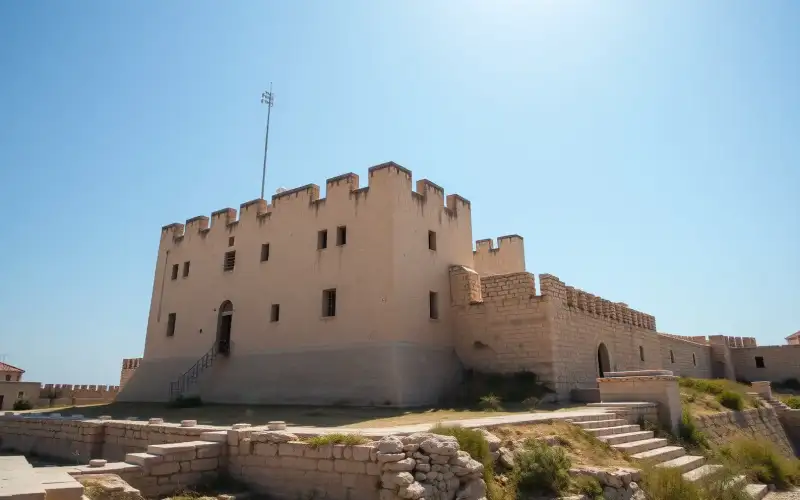
The first time I stood in the courtyard of Othello Castle, the afternoon light caught the weathered Venetian stone in such a way that I could almost see the faded emblems of the Lion of Saint Mark—Venice's ancient symbol—carved into the upper walls. That moment crystallized something I'd been chasing across the eastern Mediterranean for years: the way old fortresses hold memory not just in their stones, but in the very angles at which light falls through their windows. Othello Castle, perched above the harbour at Famagusta, is precisely this kind of place. It is not merely a ruin to walk through; it is an archive of conquest, trade, faith, and the collision of empires that defined medieval Cyprus.
Standing 40 metres above sea level on its rocky peninsula, the castle has survived eight centuries of siege, occupation, and transformation. What began as a Lusignan-era fortress in the 12th century became a Venetian stronghold in the 15th, then an Ottoman garrison in the 16th, and finally a museum piece in the modern era. Each layer tells a different story about who controlled Cyprus and why they fought so fiercely to keep it. For travellers exploring Famagusta in 2026, understanding this evolution transforms a visit from a simple historical tick-box into a genuine encounter with the forces that shaped the Mediterranean world.
The Lusignan Fortress: Birth of a Stronghold (1191–1489)
Cyprus's medieval period begins with the Third Crusade. In 1191, Richard the Lionheart, en route to the Holy Land, stopped at the island and sold it to the Knights Templar. Within months, it passed to Guy de Lusignan, a French nobleman whose family would rule Cyprus for three centuries. The Lusignans were not gentle administrators—they were feudal lords who built castles to consolidate power and protect trade routes. Othello Castle was one of their most strategic creations.
The original fortress at Famagusta was probably constructed in the late 12th century, though some historians argue for an earlier Byzantine foundation. What matters is that by the early 13th century, a proper castle stood here: a defensive structure designed to control the harbour and tax the merchant ships that passed through one of the eastern Mediterranean's busiest ports. The Lusignans understood geography. Famagusta, with its natural harbour and position on the sea routes between Europe, the Levant, and Egypt, was a goldmine. The castle was the lock on that goldmine.
During the Lusignan period, the fortress functioned primarily as a military garrison and administrative centre. Knights and soldiers were stationed here. The harbour below bustled with Venetian, Genoese, and Arab merchants. The castle's walls were reinforced, towers added, and defensive systems improved. By the 14th century, Famagusta had become one of the wealthiest cities in the eastern Mediterranean—so wealthy, in fact, that it attracted envy and siege. The castle had to be strong.
The Lusignan era was not peaceful. Famagusta was attacked multiple times. In 1373, the Genoese sacked the city. The castle stood firm, but it was clear that medieval Cyprus was caught between competing powers. The Lusignans ruled, but their grip was always uncertain. By the late 15th century, that grip had loosened considerably. Venice, which had been gaining influence through trade and marriage alliances, began to take direct control of the island.
The Venetian Period: Fortress Under New Management (1489–1571)
In 1489, the last Lusignan queen, Catherine Cornaro, ceded Cyprus to the Venetian Republic. She was not forced—she had married a Lusignan king, and when he died, she inherited the throne. But Venice had other plans. The transaction was presented as a negotiated transfer, though everyone understood it was a takeover. Famagusta and its castle passed into Venetian hands, and the fortress underwent significant transformation.
The Venetians were not primarily warriors like the Lusignans; they were merchants and engineers. They understood fortifications in a different way—not as symbols of feudal power, but as technical systems designed to withstand modern artillery. By the 15th century, cannon had changed warfare. Medieval castles with high walls and towers were vulnerable to bombardment. The Venetians redesigned Famagusta's defences accordingly. The castle's walls were partially rebuilt, bastions added, and the entire fortification adapted to accommodate cannon emplacements.
Under Venetian rule, Famagusta became even wealthier. The castle was now the administrative headquarters of a republican maritime state, not a feudal kingdom. Venetian governors lived here. Venetian merchants operated from here. The harbour was filled with Venetian galleys. The castle's function shifted slightly—it remained defensive, but it also became a symbol of Venetian commercial power and civic pride. The Lion of Saint Mark was prominently displayed.
This period of relative stability and prosperity lasted less than a century. By the mid-16th century, the Ottoman Empire was expanding aggressively across the Mediterranean. Venice, weakened by wars in Europe and competition from other trading powers, could not defend Cyprus indefinitely. The Ottomans wanted the island, and they were prepared to take it by force. In 1570, they launched an invasion.
The Ottoman Siege: When Empires Clash (1570–1571)
The Ottoman siege of Famagusta in 1570–1571 is one of the most dramatic episodes in Mediterranean military history. When Ottoman forces landed on Cyprus in 1570, they rapidly conquered most of the island. But Famagusta held out. The castle, now under Venetian command, was defended by a garrison that refused to surrender. For nearly a year, the fortress endured siege, bombardment, and assault.
The Ottoman forces, commanded by Lala Mustafa Pasha, employed the most advanced siege technology of the era. They dug trenches, constructed siege works, and brought heavy artillery to bear on the castle's walls. The Venetian defenders, under Marco Antonio Bragadin, held their positions with remarkable tenacity. Contemporary accounts describe desperate hand-to-hand combat, artillery duels, and occasional negotiations. The castle's walls were damaged repeatedly and repeatedly repaired. The garrison's supplies dwindled.
By August 1571, after months of siege and with the fortress walls crumbling, the Venetians negotiated a surrender. The terms were honourable—the defenders would be allowed to leave with their weapons and colours flying. But the Ottoman commander allegedly violated this agreement. Bragadin was executed, and his skin was flayed and stuffed with straw—a trophy displayed in the Ottoman camp. The castle fell to Ottoman control.
This moment marked a turning point not just for Othello Castle, but for Cyprus and the entire eastern Mediterranean. Venice's presence on the island was finished. Ottoman rule would last for more than three centuries. The castle that had symbolized Lusignan feudalism and then Venetian commerce would now become a symbol of Ottoman imperial power.
The Ottoman Garrison: From Fortress to Mosque (1571–1878)
Under Ottoman rule, Othello Castle underwent another transformation. The Ottomans were not primarily interested in maintaining a heavily garrisoned fortress. They controlled the entire region militarily, and Famagusta's strategic importance had diminished with the decline of Mediterranean sea trade. Instead, the castle became an administrative centre and a military installation of secondary importance.
The most visible change was religious. The Ottomans converted the castle's main tower into a mosque. A minaret was added—visitors today can still see the base of this structure. Prayer niches were carved into interior walls. The fortress that had been a Christian stronghold under the Lusignans and Venetians became, at least partially, an Islamic religious space. This conversion was not unusual; the Ottomans frequently repurposed Christian fortifications as mosques, symbolically asserting their faith and authority over conquered territories.
The Ottoman period was long but relatively quiet. Famagusta declined as a major port. The castle's garrison was reduced over time. By the 18th and 19th centuries, it was more historical monument than active fortress. The Ottoman Empire itself was weakening, and its grip on Cyprus was loosening. Local governance became more important than military readiness.
In 1878, following the Russo-Turkish War, Cyprus was ceded to British administration under the Treaty of Berlin. Ottoman control ended, though technically the Ottomans retained nominal sovereignty until 1914. Othello Castle passed into British hands, and its function changed once again.
The Modern Era: Museum and Memory (1878–2026)
British rule brought systematic documentation and preservation efforts. Othello Castle was recognized as a significant historical monument and placed under protection. The British conducted repairs, stabilized walls, and began the process of archaeological study that continues today. The castle was no longer a military installation; it was becoming a historical site for tourists and scholars.
In 1960, Cyprus gained independence. The castle remained under state protection, eventually becoming a museum operated by the Department of Antiquities. Today, visitors can explore the fortress, see the remains of the Ottoman mosque, walk along the walls, and stand in the courtyard where so much history unfolded. The castle is not heavily reconstructed or over-restored; enough original fabric remains to feel authentic, while enough has been lost to remind you that eight centuries have passed.
Visiting in 2026 means encountering a fortress that is honest about its age and complexity. There are information panels explaining the different periods, but the castle itself remains the primary text. You read it through its stones, its walls, its views across the harbour toward the old city of Famagusta beyond.
What Visitors Encounter Today: A Walking Guide
The castle is open daily from 09:00 to 17:00 (hours may vary seasonally). Admission is approximately €3 for adults. The site is accessible but involves climbing stairs and navigating uneven surfaces, so sturdy footwear is essential.
Upon entry, you'll find yourself in a wide courtyard. To your left, the remains of the mosque tower are visible—a square structure rising about 12 metres. The interior of this tower, though partially collapsed, still shows the prayer niche (mihrab) carved into the south wall, oriented toward Mecca. This is where Ottoman soldiers and officials would have prayed during the long centuries of occupation.
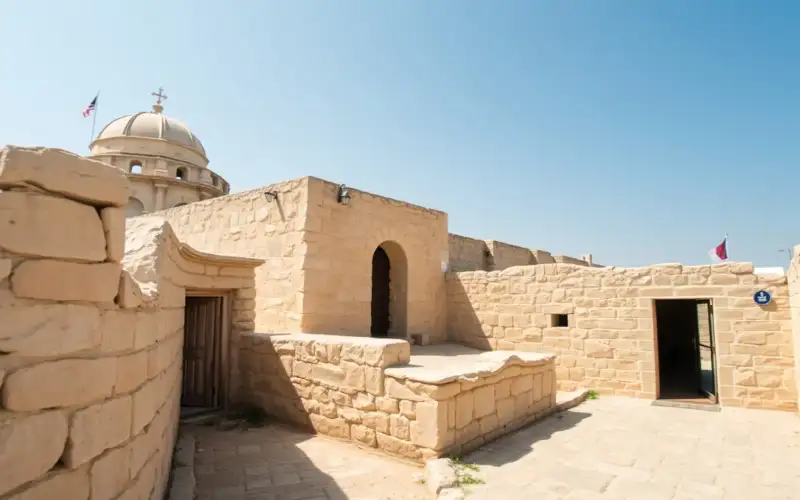
The main fortification walls ring the courtyard. You can walk along the ramparts and inspect the different construction techniques—Lusignan masonry is typically rougher and more irregular; Venetian work is more precise and geometric; Ottoman repairs are recognizable by their style and mortar. This is where a slow, observational approach pays dividends. Sit for a moment and sketch the walls, as I do. The act of drawing forces you to notice details you'd otherwise miss: the way certain stones are oriented, where previous damage has been repaired, how the light catches different surfaces.
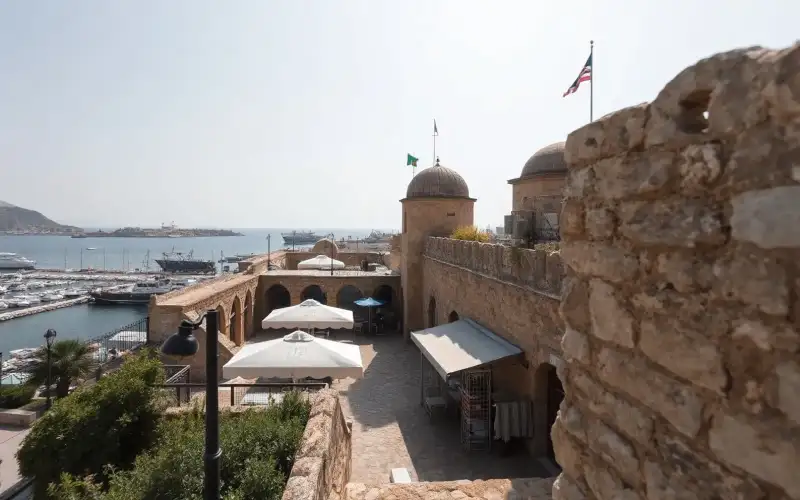
From the ramparts, you have commanding views of Famagusta harbour and the old city's silhouette. This is what the castle's defenders saw. This is why the fortress was built here. The strategic logic becomes visceral.
Othello Castle in Context: Why This History Matters
Othello Castle is not just a picturesque ruin. It is a physical record of the collision between empires that shaped the Mediterranean world. Understanding its evolution helps explain why Cyprus itself is so historically complex—the island has been fought over, traded, conquered, and ruled by powers spanning from western Europe to the Levantine east. The castle embodies that history in stone.
For British travellers in particular, the castle offers a specific lens on history. It reminds us that British rule in the eastern Mediterranean was one episode in a much longer story. The Lusignans were French-speaking feudal lords. The Venetians were republican merchants. The Ottomans were imperial administrators. The British were colonial rulers. Each left their mark; none erased what came before. The castle's walls layer all these eras together.
The castle also raises questions about cultural identity and religious conversion. The transformation of the Lusignan fortress into a Venetian stronghold and then an Ottoman mosque is not merely architectural—it is theological and political. Each conversion represented a change in who held power and what values that power served. Modern Famagusta, divided and scarred by the 1974 civil conflict, continues to grapple with these questions of identity and belonging. The castle, silent and historical, bears witness to how long these tensions have existed.
Practical Visitor Information
Othello Castle sits on the northern edge of Famagusta's old city, roughly a 15-minute walk from the city centre. If you're driving, there is limited parking near the castle entrance. The site has no facilities (no café, no toilets), so bring water and plan accordingly. The best time to visit is early morning or late afternoon, when the light is softer and the crowds are thinner. Summer heat (June–September) can be intense; spring (April–May) and autumn (October–November) are more comfortable.
A visit typically takes 1–2 hours if you're moving slowly and reading the information panels. If you're sketching or simply sitting and absorbing the atmosphere, you could easily spend 3 hours here. There is no entry fee to the courtyard area, though the tower interior may require a small donation.
Consider combining a visit to Othello Castle with exploration of Famagusta's old city walls and the Cathedral of Saint Nicholas (now a mosque). These sites are interconnected and tell overlapping stories about the island's history. A full day in Famagusta, moving slowly and allowing for reflection, is time well spent.
Final Reflections: Why Othello Castle Matters to Slow Travellers
In an era of rapid tourism, where travellers tick off attractions and move quickly to the next destination, Othello Castle invites a different approach. The fortress demands slowness. It rewards the traveller who sits, observes, sketches, and thinks. The layers of history are not presented as a coherent narrative; they are embedded in the stones themselves. You must do the work of interpretation.
This is what draws me back to places like Othello Castle, year after year. Not the convenience or the spectacle, but the depth. The castle's transformation from Lusignan fortress to Venetian stronghold to Ottoman garrison is a metaphor for the entire Mediterranean's history—a region where empires collide, cultures blend, and nothing remains static. To stand in that courtyard and contemplate these transformations is to understand something fundamental about how the world changes and how the past remains present in the landscape around us.
For British travellers exploring eastern Cyprus in 2026, Othello Castle offers more than historical curiosity. It offers a mirror in which to see how empires rise and fall, how cultures adapt and persist, and how the physical world preserves memory long after the people who built it have vanished. That is worth the journey to Famagusta. That is worth the climb up the castle walls and the hour spent sitting in that courtyard, watching the light shift across eight centuries of stone.

Comments (4 comments)